
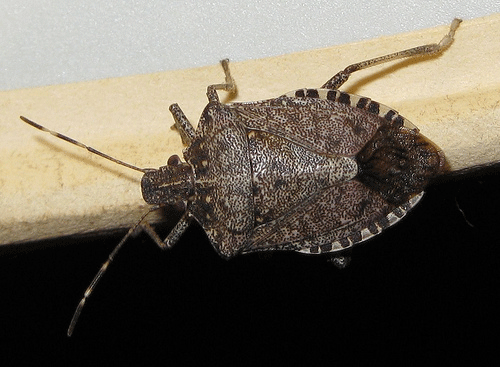
Picture by sameold2008 at flickr
A while ago in a comment here, John Cowan explained that the word ‘robin’ is used to describe two entirely different species on each side of the pond. It reminded me of some perils I’ve encountered here with wild things.
I wrote about the hazards for Brits driving in the US before, but neglected to mention that in spring and autumn/fall, you have to watch out for deer hurling themselves before the wheels of your car. Also I found it very odd when I first moved here to hear public radio announcements asking us to secure lids on trash cans so bears couldn’t forage for food. Bears – goodness! In fact when we were living in the ‘burbs, a neighbour of ours ran into a bear!
Where we live now in center city Philadelphia, skyscrapers grow like trees. But compared to south east England, it still seems a bit more – well – wild. I have a little office at home where I received the flying visitor pictured above last summer. I’ve been told that, like me, it’s a fairly recent immigrant to the US, and it’s called Halyomorpha halys, or more commonly, a stink bug. It gets very hot here in summer so bugs tend to be larger and a bit more ferocious. This one doesn’t bite but it makes an alarming noise. And as I mentioned to John, birds sound more savage here too. They have names like chicken hawks and turkey buzzards. It’s as if American birds just don’t give a damn about what they copulate with.
Some other things that surfaced in our lives when we first moved into Center City were cockroaches. Argh! But interestingly, after another house move just three blocks up the street, they have disappeared again. (Hooray and touch wood!) But what’s stopping them from strolling just three blocks along the road, I wonder? Goodness knows, but here’s hoping they will never find their way.
What wild wild life encounters have you had in your travels?
By: Sid Mosdell
Chickenhawks are hawks that supposedly eat chickens, though in fact chickens don’t form a substantial part of their diet. Turkey buzzards are so called because they look a little bit like wild turkeys. They are also called turkey vultures, and “vulture” is another name that means different things Over Here and Over There. Both groups are carrion eaters and have featherless heads and necks, but whereas Old World vultures are a subgroup of hawks, New World vultures are not — they were formerly thought to be closely related to storks and herons, but it’s not clear what their nearest relatives actually are. The similarity in appearance is due to the similarity in lifestyle: if you eat carrion, you don’t want to get bits of it on your feathers, so better not to have any.
American black bears are found in all 50 states, and they love suburbia because of the ample supplies of food in garbage cans. Grizzly bears, which are the true equivalent of the European brown bear, are much rarer and much shyer.
Traditional advice for what to do when attacked by a bear:
1) If it’s an American black bear, it’s starving or it wouldn’t bother you. So fight back: use a weapon, throw stones or even sticks if that’s all you have. You want to convince it you’re not worth trying to eat.
2) If it’s a grizzly bear, you’re in its territory. Fall down and play dead. Bears won’t eat carrion (they live mostly off vegetable food and small animals like mice), so even if it turns you over to see if you look dead enough, it will eventually leave you alone as long as you hold still.
3) If it’s a polar bear, it doesn’t matter what you do. If it attacks you, you will be killed and eaten.
Enjoy our wild America!
Ha! Oh John! Thank you so much for penning this wonderful response. I can’t begin to explain how foreign all this still sounds to this Brit. I keep switching between entranced and bemused – entranced, bemused, entranced, bemused…
Now I must memorize this: Black bear – fight back, Brown bear – play dead. Clearly mixing them up would be hazardous. But where did you learn this stuff? And do kids here get taught this stuff in elementary school? Coming from a tamer part of the world, I fear I might have missed out. I doubt if it ever crossed my teachers minds to drum this (now) really important stuff into me.
Alas, my American schools have also neglected my bear self-defense education. I imagine most of the common knowledge comes from the boy scouts, who undoubtedly enjoy scaring the rest of us during camping trips.
Also, I’m probably not the best source, but I’ve heard that bears aren’t very good at running downhill due to their short front legs.
Oh Trent, Ha! Thanks so much for joining in. But you see, the very fact that you have heard that bears aren’t so good on the down slopes demonstrates a higher level of knowledge to that we’d acquire in the UK!
Hi Vicki,
Icky stinky beasties do seem to be a real plague.
Not sure whether I should share this story, it’s not for the fainthearted, so be forewarned and do feel free to press ‘delete’:
My first job was at an icecream parlor on Capital Hill, with tongue-in-cheek political names for its sundaes – think “scoops”! I was just 16, and unafraid, so when one day the exterminators came to take care of those stray cockroaches we’d seen, I was the poor soul scheduled to open up shop the following morning. Had some public institution seen the place, they would have condemned it on the spot. Half-dead besties crawling everywhere. Floors, counters, walls. The worst bit was overhead. You know those wall-to-wall ceiling lights, big panes of corrogated glass held up by bands of steel? I had to lift them gingerly and sweep moving black spots to the ground. As they say in DC: baby, you just ain’t seen nuthin’ yet! 😉
So, Vicki, here’s hammering on wood with you. If you do find you have to call the exterminator, get all of your neighbors to join you, because as you say, they will travel.
Good luck!!
Oh thanks very much for this Anne. I’m actually not too faint hearted about cockroach stories. My dad was a baker in the east end of London and he used to tell a tales of walls encrusted with them. They were attracted to the warmth of coal fired ovens of his day. When a wall was knocked down in one of his workplaces, they ran in force out across Petticoat Lane and became a bit of a legend in the street. Strangely the exodus led to the baker’s becoming known as ‘a clean place’. I always thought that was a strange perception on the part of the public.
My brother, a baker too but in a different era, had lots of training in how to deal with them. When I wrote that we’d discoivered they inhabitated an apartment we lived in, he sent me this sage advice:
“….As a techie may I fill you in on roaches. Last week I attended an advanced hygiene course for food industry supervisors and we spent an interesting 30 minutes discussing the social habits of the cockroach. This might sound disgusting but it made a pleasant break from the social habits of rats, ecoli clostridium, listeria and campylobacter (why does that always sound as though it ought to be roaming around in Jurassic Park?)
Cockroaches are supposed to be the most indestructible life form on the planet. They can survive drought, famine, disease, heat, cold and radiation. They say that if there were ever to be a nuclear war the only two things in the world that would definitely survive would be cockroaches and income tax.
How to manage them? Well certainly do not stamp on them. Their eggs incubate within their carapace and if you squash them and then tread the eggs around the place you are set for an epidemic. You might already have taken some of the correct steps. Deny them food by placing everything in sealed containers. They are often in the drains and will come out into the kitchen at night. It is not always a good idea to block off the drains. At least you expect them in the kitchen. If you deny them the obvious exit point you may have the unpleasant experience of them coming up through the shower, or even worse the toilet bowl.
What I cannot understand is why they are called cockroaches. Does this not smack of womens lib prejudice?
I give below my own prefered solution.
1 tblsp Olive Oil
2 Cloves crushed garlic
1 Choped red pepper
1 Kg Cockroaches
1 bottle of red wine
Heat the oil. Fry the garlic, red pepper and cockroaches until crispy.
Drink the red wine. Throw the cockroaches away.
Love!!!
Cockroach is an adaptation of the Spanish word cucaracha to the familiar English words cock and roach, a process called “folk etymology”. The same thing also gives us sparrow grass for asparagus, crayfish for French écrevisse, and Rotten Row for Route de Roi.
I grew up in south London watching Yogi Bear cartoons.
Years later i was driving near Whistler in Canada when a bear ambled across the road and disappeared into the forest.
I stopped the car, got out and followed.
I could hear where it was so set off after it.
Each step into the woods left me a little more uncertain, this is not my place, so i abandoned the chase.
I grew up in the suburbs watching Flipper the Dolphin TV shows.
Years later i was in Mexico watching every morning as Dolphins crossed the bay where i was camping.
After a week i decided to swim with them and as i saw them approaching i started to wade out.
Each splash led me deeper, each depth eroded my confidence.
Those fins look like sharks!
I grew up in England watching old Fu Manchu movies.
Years later still in Mexico i set off for a walk in the desert.
I noticed lots of little insects scurrying from my path and i decided to investigate.
They were fast, i ran after them.
They were scorpions.
These things can kill you!
I ran the other way.
(Oops, saved too soon)
Just to confuse you, black bears out West are most often brown, cinnamon, or even pale yellow to white. They do have very different faces from grizzlies, though, with snouts more like pigs. In any case, you are very unlikely to encounter a grizzly unless you do lots of mountain hiking in Alaska or the Northwest. Americans tend to be fascinated with them, and there are lots of public television programs about them.
I’m not sure where exactly the “traditional advice” comes from, but the Boy Scouts sound like a good candidate. In rural areas, kids probably learn bear rules from their parents, including the rule that when camping in the woods, you put your food in a bag and hang it from a tree so that bears and porcupines can’t get at it during the night. (Porcupines will even steal and chew leather boots for the salt content.)
Deer on the highways are usually more a danger to themselves than to you. Last year, my wife was driving at night when a deer ran out into the road in front of her. She slowed abruptly, but instead of continuing to cross the road, the deer slowed up and then turned to run back the other way, so that she couldn’t avoid hitting it. It was thrown clear of the roadway and into the woods out of sight. We were shaken up psychologically but not injured, so we called 911 and reported the incident, and were told we didn’t have to wait for the police to show up. The car was damaged a bit, but insurance covered it.
Moose are another story. In Maine, there are regularly updated road signs showing how many people have been killed in moose accidents during the current year. The trouble is that the belly of a moose is about 6 feet off the ground, so it’s above the line of sight of a driver when it crosses in front of you, which they often do. In such a situation, you aren’t likely to notice the thin and fragile legs, and when you hit them, they break and 800-1600 pounds worth of moose collapses on the roof of your car, killing both of you. (Moose, by the way, are larger versions of the European elks found in Scandinavia, Poland, and Russia; in America, the name elk is instead applied to a smaller deer that is either the same as, or closely related to, the red deer of continental Europe and the Scottish Highlands. Hence the tale of the Scotsman visiting America who is taken to the local zoo, where he sees among other creatures the moose. His comment: “If that’s your moose, I dinna want to see your rats!”)
So amused by all these tales and John’s explanations that I will tell my first near-death experience (the one before the waterfall)… and there are others, it’s not for nothing I believe I have somethng in common with cats.
Soz…
I’d left London is a flurry and left my entire left behind. I was 24 and there was only thing on my agenda. I would have a life fully-lived. On the plane, I read about a monastery in the south of Thailand called Suan Mok which accepted foreigners for 10day Vipassana retreats. It would cost almost nothing to do but the catch was no speaking for the entire time.
I got into Bangkok late in the evening and exited the airport unsure of what I was going to do – took in the warm sticky swell of heat – I spoke not a word of Thai so when a TukTuk driver approached, I nodded and said hotel – he mumbled something like HolidayInn or some big name chain and I shook my head and gestured money with my hands. Koh San, he said, I shrugged and let him guide me through a swarm of automobiles, noise and dark grey pollution.
The next day I managed to find the Southbound Bus Terminal as opposed to the Northbound Bus Terminal and a fleet of gestures communicated that I wanted to go near to Surat Thani to a monastery.
I attracted attention, a chawtangchati, with her big blue backpack and 2 carry ons but I didn’t care, I kept smiling and kept bowing my head and clasping my hands SawatiKa…
*Life not left in 2nd paragraph – ah, must spellcheck and edit b4 I hit publish)
Continuing on…
The bus driver kicked me out sometime in the middle of the night. Perhaps it was 3 or 4 in the morning or perhaps it was earlier. He’d shook my shoulders and said “SuanMOk- you get off now – you get off”
I’d been sleeping, camera and money logically strapped to my stomach, and when I shook off the cobwebs of being awakened so roughly, I realized the rest of the bus was fast asleep.
No one stirred as I followed a short Asian man to the front of the bus. “You get off” he said again, not friendly, not the typical Thai hospitality they are so deservedly famous for. I didn’t want to get off, I had no idea where I was but gingerly made my way off the stairs. The bus took off. “My luggage!”
I panicked until I saw it lying in the grass ditch beside me.
I watched as the bus lights started fading in the distance, staring at the asphalt and white lines down the middle, took in the stirring grasses and the chirping buzzing night insects.
There was not a single house or hut in sight. There certainly wasn’t a monastery in sight. The air had cooled as I suddenly realized I was on a main road, completely alone and female.
Behind me a high wall of grasses – well as far as I could tell with only the penlight attached to my keyring.
I had a choice.
Risk the beasts or be visible to whomever would be travelling along the highway. I chose instead to drag my bags down through the ditch, sat on my backpack and waited for the morning to come.
am realizing this story is too long to tell within the comments of your blog… will have to break my break and finish it on Kalinago! Tomorrow :D, am supposed to be textbook-unit-outlining until your post so cleverly distracted me!! sorry for taking up so much space!
OK, so it’s not the UK or US but you might like this little tale of an unexpected visitor to my office in Sri Lanka: http://cliveinsrilanka.blogspot.com/2010/06/uninvited-guest.html
BTW, isn’t it “knock on wood” in ‘merican? 😉
@CliveSir
Chris, your story reminded me of an encounter I had years ago with another kind of beastie. I was walking along a quiet road one day when a guy opened his raincoat, flashed me and then turned tail and ran when I shouted at him. I gave chase and I was gaining on him when I thought – what am I doing? What if I catch him? Ha! I turned round and ran the other way.
Ah dear! Loved that moose story John!
Karenne, you can’t leave us at the side of the road like this! We’re on the edge of our seats here.
But hang on – does this mean you might come out of retirement to make a post on Kalinago English http://kalinago.blogspot.com/?
Oh well, if that’s the case – no problem and I’ll look forward to finding out what happened tomorrow.
(Great story – thank you!)
Crikey Clive! Great to meet you and that’s one big wild beastie! If you haven’t already done so folks – go check out the pictures at: http://cliveinsrilanka.blogspot.com/2010/06/uninvited-guest.html
And you’re right! Folks knock on wood here. Well, I never! I’ve been saying touch wood for a dozen years and nobody has ever mentioned it before. Sometimes ‘mericans are just too damned polite.
We positive-politeness Yanks would never dream of telling you you talk funny: it would ruin our solidarity with you. Except in technical contexts like this blog, where Bald On-the-Record is the strategy of choice, as you can see. 🙂
Ha! Just love your bald on the record style John!