Vicki

Teacher of professional and technical English, writer and teacher trainer.

Jun 242011
 

Over on the east coast (where I’m based) it’s easy to forget that Spanish is the second most used language in the United States. According to Wikipedia it’s spoken at home by more than 35.5 million people aged 5 or older.

So I was tickled by this video of Tom Hanks delivering the weather forecast on a Spanish TV channel. Lots of ELF (English as a Lingua Franca) features are evident here:

  • if you don’t understand, keep smiling and hope you’ll catch on later ( ‘letting it pass’ is the term coined by Alan Firth – see more on that here)
  • people will speak slowly to accommodate (It’s just good manners. Ettiquette may vary in all sorts of ways across cultures but it’s the human condition to want to help)
  • on a similar point – look at all the code switching that’s going on here. Hey Tom, we don’t care if you answer us in whatever language you can cope with and think is going to be most comprehensible and express your thoughts best. We’ll adapt.
  • a lot of shared understanding transcends language and derives from modern culture (e.g. we all know that newscasters performing in front of a greenscreen can’t actually see what region on a map they are pointing to)


Hope you enjoyed it too. If so, let me know with a thumbs up or comment. I’d love to know what mainland Spanish speakers might think of this too.

 

 Posted by at 4:43 am
Jun 102011
 

I’m very interested in the curious relationship benefits that can result when human beings are ambiguous and don’t state their intent clearly. So I was delighted to discover Steven Pinker exploring the issue in this RSA lecture.
It’s a terrific talk, but if you don’t have time to watch the whole 11 minute video, try to watch it from 7 minutes in. He uses a wonderful example from the movie ‘When Harry met Sally’ to illustrate and explain why direct on the record statements can be less comfortable and more awkward than indirect ones. And if you don’t have time to watch any of it, in short he maintains it’s because lack of mutual knowledge helps us to maintain a fiction.

Click here to read another post on ambiguity in polite requests

 Posted by at 10:37 pm
Jun 092011
 

One of the wonderful things I’ve discovered living in the US is Americans have different take on history to me. For example, up the road at Independence Hall they seem to think the Declaration of Independence signalled the birth of a nation rather than viewing it as an act of treason. And up in Boston I noticed ‘no taxation without representation’ was viewed as a legitimate claim. I can sort of understand that, but I wonder why us claiming taxes to cover their share of the costs for their wars with the French wasn’t legitimate too.

But fellow Brits, don’t be fooled by this into imagining that ‘mericans don’t know historical fact from fiction. Events may be interpreted a little differently and Sarah Palin may have a whole other perspective , but as Conan O’Brien illustrates in the skit below, Americans know but they just seem to laugh about it.

Please don’t ask me to explain why Americans do this because it’s still a puzzle to me. My best guess is, as I’ve noted elsewhere, there seems to be a greater willingness to dispense with historical accuracy if it starts getting in the way of other more important stuff like having FUN.

Interestingly though, after a dozen years living here, I appreciated and ROFLed when I watched the video in ways I don’t think I could ever have ROFLed when I was living in the UK. Maybe I’ve grown more accustomed to a less understated style of parody? Or maybe I’m starting to pick up on and enjoy more cultural references?

So here’s my question to folks who have been living abroad for a while. Have you found your sense of humour changing over time?

 Posted by at 10:35 pm
Apr 282011
 
Picture by sameold2008 at flickr

Picture by sameold2008 at flickr

A while ago in a comment here, John Cowan explained that the word ‘robin’ is used to describe two entirely different species on each side of the pond. It reminded me of some perils I’ve encountered here with wild things.

I wrote about the hazards for Brits driving in the US before, but neglected to mention that in spring and autumn/fall, you have to watch out for deer hurling themselves before the wheels of your car. Also I found it very odd when I first moved here to hear public radio announcements asking us to secure lids on trash cans so bears couldn’t forage for food. Bears – goodness! In fact when we were living in the ‘burbs, a neighbour of ours ran into a bear!

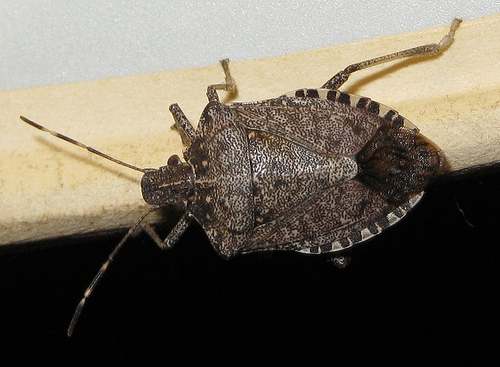
Where we live now in center city Philadelphia, skyscrapers grow like trees. But compared to south east England, it still seems a bit more  – well  – wild. I have a little office at home where I received the  flying visitor pictured above last summer. I’ve been told that, like me, it’s a fairly recent immigrant to the US, and it’s called Halyomorpha halys, or more commonly, a stink bug. It gets very hot here in summer so bugs tend to be larger and a bit more ferocious. This one doesn’t bite but it makes an alarming noise. And as I mentioned to John, birds sound more savage here too. They have names like chicken hawks and turkey buzzards. It’s as if American birds just don’t give a damn about what they copulate with.

Some other things that surfaced in our lives when we first moved into Center City were cockroaches. Argh! But interestingly, after another house move just three blocks up the street, they have disappeared again.  (Hooray and touch wood!) But what’s stopping them from strolling just three blocks along the road, I wonder? Goodness knows, but here’s hoping they will never find their way.

What wild wild life encounters have you had in your travels?

 Posted by at 11:12 pm
Apr 262011
 

Television news programs here seem to be devoting a lot of time to the royal wedding. But are Americans really that interested? And how much do they know about the British royal family? I thought I’d ask some and find out. Speaking as someone who couldn’t recognise half the look alikes in the BT royal wedding video, I was very impressed with how much some these folks knew!

This works as a lesson for your English class. Your students answer the questions and then compare their answers with the people in the video. I guess  the logical final task would be to try to construct a royal family tree. Ha! Good luck with that!

I’ll try to post a version with no music and closed captions later today, so watch this space.
And finally – many many thanks to the kind folks who allowed me to interview them on a very hot sunny day.

UPDATE!

Here are the questions I asked:

  • Do you know much about the British royal family?
  • Do you know the names of the people getting married?
  • Do you know any other members of the royal family?
  • How do you know so many names?
  • Is there too much or too little about the wedding on TV?
  • Are you going to watch the wedding?

Click here for a full script of the video with the answers I got:  Royal wedding video script

As promised, I’ve also made another version with closed captions. The captions don’t always pop up at precisely the right moment, but you may prefer to use it rather than the script. It’s available on youtube too – just click here (Press the ‘cc’ button bottom left to turn the captions on.)


 Posted by at 1:16 pm