Vicki

Teacher of professional and technical English, writer and teacher trainer.

Feb 112011
 

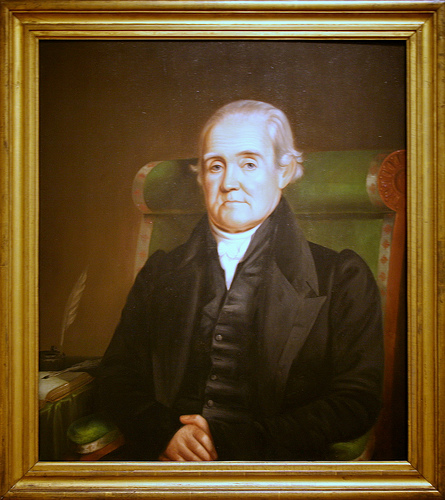
Ever wondered about the guy who masterminded the Americanization of English spelling? Here with a guest post us about him is Adam Simpson, writer of the wonderfully energetic and eclectic ‘One year in the life of an English teacher’ blog. Over to Adam…
By: Cliff

At the tail end of the eleventh century, the Byzantine emperor Alexios I wrote a letter pleading Pope Urban II for ‘hired muscle’ in the fight against the Muslim advances into the Byzantine Empire. The direct result of this letter was a series of religiously sanctioned military campaigns, waged by much of Roman Catholic Europe, with the aim of restoring Christian control of the Holy Land. These campaigns, which would come to be known as the Crusades, would continue being fought over a period of nearly 200 years. What does all this have to do with us as English language teachers? Well, it shows us the effect of one person’s written work, and how the repercussions of such writings may still be felt centuries later.

Although, thankfully, much less of a bloodbath has (so far, at least) resulted from his collected documentation than that of Alexios I, the words that Noah Webster put down in writing made him the archetypal language Crusader, one whose actions are still very much being felt today. For Noah, you see, was the founding father of the phenomenon we refer to as American English (thus, by default, making him also the founder of modern British English).

Webster was quite the man; an American lexicographer before such a thing existed, a textbook pioneer who thought that Americans should learn from American books, (resulting in his compendium, A Grammatical Institute of the English Language), an English spelling reformer, a political writer, an editor, a slavery abolitionist and a prolific writer to boot. Basically, it’s not for nothing that Webster is referred to as the father of American scholarship and education. In essence, it’s very much down to him that his country folk might nowadays say, ‘He de man!’ Indeed, such has been Webster’s influence on the language that in the United States his name is synonymous with the very notion of ‘dictionary’. Consider this: Webster was seventy years old when the 70,000-word An American Dictionary of the English Language was first published in 1828. What should have been his magnum opus actually sold very poorly: only 2,500 copies. This didn’t deter the septuagenarian, who even had to re-mortgage his home to be able to finally publish the expanded second edition. Although he died with his language reform work still relatively unrecognized, it would all pay off eventually. Today the world knows the contemporary version of this volume as the Merriam-Webster dictionary, the Merriam brothers having bought the rights to the name after Webster’s death in 1843.

Dictionary

Slowly but surely, over the course of the inconceivable 385 different editions that were published during his lifetime alone (with many more after he died), Webster effectively ‘Americanized’ the spelling of words in the ways that we know and love today. For example, he quickly chose s in place of c in words like offense and defense, he changed the re to er in words like center and theater, and he even dropped one of the Ls in traveler. Other things would take longer to get the Webster treatment: he kept the u in words like colour or favour for a long time, but eventually dropped it in later editions. Although it seems so simple now, Webster didn’t take this task lightly. He purposefully learned twenty-six languages, including Old English, German, Greek, Latin, Italian, Spanish, French, Hebrew, Arabic, and Sanskrit so that he could evaluate the etymology of words.

Evolution teaches us that isolated populations will eventually evolve to the point that they share little with their common ancestor. While modern communications mean that the world’s islands of English are now inseparable in a way that has never previously existed with languages that have managed to span the globe, we can still see the influence that this exceptional man had on the evolution of the language. So, every time you are asked about the differences between American and British English, you know who to blame!

Further reading

‘Noah Webster’ in The Cambridge History of English and American Literature in 18 Volumes (1907–21). Vol. 18 section 25:33 http://www.bartleby.com/228/0233.html

Ellis, Joseph J. 1979, After the Revolution: Profiles of Early American Culture. Ch. 6 http://www.questia.com/PM.qst?a=o&d=101499638

Thanks for very much for this piece, Adam!  I have to say I’m impressed by some of Webster’s spelling rationalizations though I need to keep practising. I used to write a column for a local newspaper here where my British spellings caused havoc. When I wrote about things like my neighbours, travelling, the theatre, changing a tyre, wearing pyjamas and honouring cheques, they said it paralysed their computer programme.

 Posted by at 6:07 am
Jan 292011
 

The British version of the American “Law and Order’ TV show is currently running on TV here. My ‘merican husband’s a fan, but at the end of every show he comes up with a phrase or two he wants me to translate. So we were tickled to see an ad for the show running tonight that was akin to a glossary. It went like this:

My lord… My lord… My lord… My lady… My lady… My lady…
It’s like our ‘Law and Order…just more British
wanker = insulting name
bent = corrupt
rubbish = nonsense
queuing up = lining up
blimey = I’m surprised
brilliant = fantastic
nappy = diaper
bollocks = nonsense
bloody = mild expletive
flat = apartment
mum = mom
mate = friend
bloke = dude
knackers = testicles
flog = sell
baubles = trinkets
pounds = unit of currency

UPDATE: To my delight I’ve just found a longer version of the ad on youtube. How Americans see the curious habits of Brits… Enjoy!


 Posted by at 4:20 am
Jan 202011
 

http://www.flickr.com/photos/quinnanya/3286039442/

When do we address someone  by the term  ‘Professor’? Anne Hodgson has just raised this and other interesting questions about ‘college talk’ around the world in her blog .

Americans have a reputation for informality. But there ways in which I think folks are more formal and attached to ceremony here than in Europe. One of them is the ‘Professor’ title. My impression is it’s accorded more liberally in the US than the UK.

I think it stems from politeness and positive face issues. As a Brit, I’m uncomfortable being addressed as ‘professor’ when I’m working at the University of Pennsylvania or the New School. It’s like receiving a compliment I don’t feel I merit. And I probably should know better because I realize it’s generally just a matter of routine. In British terms, it’s akin to someone at my bank calling me Mrs or Ms when they call me up. But it’s actually quite hard to think of British equivalents because I think we tend to use titles less in the UK. (‘Ma’am’ is another one I only hear in the US)

I wonder, am I’m undermining my students’ status when I say ‘Don’t call me ‘Professor’’? If their teacher is putting themselves down, might it imply that they’re getting put down too. Oh what tangled webs we weave.

Other posts on similar topics:

Terms of endearment

Compliments

 Posted by at 10:05 pm
Jan 182011
 

I came across this lovely video clip via an article by Andy Field in the Guardian. It shows John Cage, a pioneer in experimental and chance music, performing an avant-garde composition on an American TV game show in the 1960s. Yes really! An avant-garde musical composition a TV game show.

I love the gentle good humour and graciousness with which John Cage delivers his work. (And now I’ve written that, it’s struck me that I think ‘graciousness’ might be word that I’ve heard more since I’ve been in the US). There’s a charming earnestness about him and I loved this line:

“Perfectly seriously, I consider music the production of sounds and since in the piece you will hear I produce sounds, I would call it music”

Could a similar performance have ever happened on a UK game show, I wonder? Would the content editor have deemed it too high brow, and hence unfitting? And if it had gone ahead, would it have required a more tongue in cheek approach and would John Cage have received the same amused, open-minded reception? And how lovely that he did, because he seems to have wound up going down a storm. Andy Field draws an interesting comparison with ‘Britain’s Got Talent’.

In Simon Cowell’s universe you’re either a future star, a lovable object of derision or an unlikely underdog about to undergo a heart-warming transformation; in each case, your treatment is predetermined by which pigeonhole you’re placed in.

Are we that blinkered? I hope not. Nevertheless, I do think the clip might illustrate something that relates to the different weightings placed on positive and negative politeness on each side of the pond. If you’re inclined to hesitate before you dismiss things, you probably have to accept more dross in your life. But maybe you also wind up coming across more new stuff that can enhance life as well? Any thoughts?

Other related posts:

Susan Boyle and UK and US audiences

Openness

 Posted by at 12:20 pm
Dec 132010
 
Something a little different today: America is home to many immigrants and here with a tale of one of them is a guest blogger – Alvina Lopez. Without ado, over to Alvina…

Learning English and Losing a Culture

mealMy close friend Annie was the first child in her family to be born on American soil, and the first to master English. When she began school, she spoke only Cantonese and she struggled in the English program she was placed in. So her family began learning English with her and every evening Annie sat with her father listening to rented English tutorial cassette tapes. Around the house, they spoke nothing but English to help her along. In two years, Annie had gained fluency in English, but it came at a price. Cantonese words and expressions began to slip away.

After graduating and coming home to attend the first Chinese New Year gathering with her family in years, she found herself at a loss when her mother addressed her in Cantonese. “Tell your grandmother about what you learned in school,” her mother said. Annie opened her mouth, but nothing came out. Her eyes widened when she realized she had no idea how to talk about grades, studying, and classes. Her grandmother waited expectantly, but Annie could only stammer broken sentences, mangled with English words in place of Chinese ones she had forgotten or never known. She found herself with the complex thoughts of a 26 year old woman, but the language proficiency of a four-year-old child.

“My granddaughter, your Chinese has deteriorated,” her grandmother said in Cantonese, laughing. “Soon, we will not be able to speak any longer!” But Annie’s parents didn’t find it funny. “You’re not Chinese anymore,” they scolded her after they’d left the party. “You are American!”

But does forgetting the language truly mean that she’s no longer Chinese? She is close with her Chinese parents and she still celebrates Chinese customs, so how much does language have to do with identity? Her extended family is more distant to her now and she suspects that some of them may not trust her any longer because they cannot speak together. Formerly close grandparents, aunts, and uncles feel more like strangers as Annie finds herself unable to express her thoughts.

Chinese New Year's Parade; NYC

One Chinese New Year, Annie took me to Chinatown for the celebrations. As we watched the lion dancers performing their number, once in a while a Chinese announcer would shout something that made the crowd hoot and holler. Annie and I did the same, but afterwards when I asked her why exactly we were cheering, she shrugged.

“I don’t really know. I can’t understand what the announcers say anymore, so I just cheer when everyone else cheers,” she said.

Annie feels language is a big part of her identity. “I speak American English fluently, and it is the only language I speak fluently, so that must mean that I am American. I also think like a lot of Americans do, and I do the same things that Americans like to do and eat the same things, too,” she says. But Annie also still knows some Chinese, so she still feels that a part of her is Chinese as well. “I have made peace with the fact that I lost a part of my Chinese cultural identity when I learned English. It makes for a more accurate representation of who I really am now anyway, and I am someone whose culture is no longer 100% Chinese, but actually part American and part Chinese.”

This guest post is contributed by Alvina Lopez, who writes on the topics of accredited online schools. She welcomes your comments here and at her email: alvina.lopez @gmail.com.
 Posted by at 12:40 pm