I tried using a greenscreen in my last video post and got rumbled very quickly. Ha! But undeterred, I thought I’d have a stab at another video post today, with a lot of help from the Fleischer studios.
Dec 062010


Something I find very bothersome about having one road that goes over the top of another is what winds up happening underneath. It can result in threatening dark places at night, especially in the centre of a city where folks can buy guns at their local Walmart. I was entranced by the transformation achieved with some LED lights at this underpass near my home.

Speaking of refrigerators (I’m hoping Jessica will keep coming back, because I loved her response), I enjoyed some of the words and expressions in this AmE ad from the 50s. Have a listen. Are there any you especially like too?
American readers, please help me out and correct me if I’ve got stuff wrong here. I think ‘Jeepers’ is long gone from AmE (along with others like ‘swell’ and ‘holy mackerel’ – shame, eh?) And probably ‘Boy, oh boy’ too, though I’m less sure about that.
‘Gee’ is interesting. I’ve heard it occasionally, so I think that while it’s less popular it’s still lurking. An expression that isn’t in the video that I’ve definitely heard is ‘Yes, indeedy’. I don’t know if it’s a Philly thing and I don’t hear it that often, but when I do, it always makes me grin. It packs such enthusiasm. Which brings me to something else that struck me in this video: the use of the word ‘sure’.
That sure is.
Sure, Pop.
We sure can.
I think these would all work today so I’m guessing these ‘sure’ uses seem to have endured the test of time in AmE. So what’s the implicature ? In semantic terms, sure‘s meaning is tied up with certainty, but in pragmatic terms, isn’t it more about enthusiasm or willingness? I ask because I think it might be a good example of the limited meaning we might be teaching if we choose to focus on semantics alone.
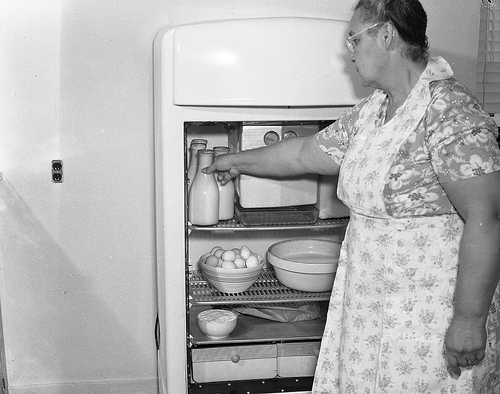
Speaking of FUN, I’d like to say a few words about American fridges. Firstly, of course, folks don’t call them that here. I once called up Sears and found myself talking to an automated answering machine. ‘Which department do you want?’ ‘Fridges’ ‘We do not recognize that request.’ ‘Rrefrrrrigerratorrrrs.’ I got straight through.
Fridges are dinky things. I never thought so at the time I had one, but I know that now I live with a refrigerator. Should I ever want to, I can climb in, chill and stretch out. And what’s curious is that when we return with the shopping, just like a fridge, there still isn’t enough room.
Refrigerators are open spaces, where trespass isn’t an issue for your pals. Fridges, on the other hand, are private spaces and guests rarely enter without checking first. That hadn’t occurred to me either, until the first time an American friend strolled over, opened the door, and helped himself to a cold beer.
‘But what’s all this got to do with FUN Vicki?’, you may be asking. Well, nothing in particular, except I thought you might enjoy a minute or two of this appliances ad from the 50s. These guys seem to be having the time of their lives.
Oh my, are you in for a treat! I’ve got a guest post for you from none other than everyone’s favourite ELT blogger – the thoroughly TEFLtastic, Alex Case. Without ado, over to Alex.
 As I’m British, I have to admit that my biggest problem with American English is a knee-jerk negative reaction to Americanisms, especially when they are used by people back home. I would love to believe that I could one day fully accept more logical American forms like ax, or at least find out if words really are Americanisms before showing my disgust. Unfortunately, that instant snobbish sneer seems to be a cultural norm that I just can’t lose.
Ironically, my second largest problem is that a prime example of an Englishman who can’t keep the American English tide back is me. After ten years abroad, I can’t remember the last time I said corner shop, cashpoint, or first floor for the one that isn’t on the ground. I must say that the extreme reaction I get for saying convenience store and ATM back home is a bit over the top. What is it with these Brits? Do they think they are superior to the 99% of the world that uses those expressions? Apparently we do…
My next problem with American English is those bits that I have yet to come across, let alone pick up myself. The number of times I have corrected students only to later find out that what they said was perfectly acceptable American English are too numerous to mention, but they include “puzzle” for jigsaw, “robe” for dressing gown, “dish” for a plate, and “toaster oven”. That has caused me even more angst over the years as I’ve realised that becoming the teacher I would like to be doesn’t just involve thinking up more game ideas, but also entails the deeply tedious process of learning about my own language when I’d much rather be learning Moldovan or Bengali.
I’m hardly alone in the problem above. One clear sign of that is the number of online lists of typical mistakes for particular language speakers (Franglais etc) that include perfectly acceptable American English. To make me feel better, the number of lists by North Americans correcting their students for using British English is even greater.
Becoming too aware of the danger of correcting a student for something that turns out to be correct somewhere can lead to problem number 4 – blaming all student errors on American English. For example, most British teachers in Japan and Korea blame the Japlish and Konglish word “muffler” (a winter scarf) on Americans. Strange that, because most Americans assume it is British English. Of course, if I properly knew my own language as it is spoken beyond the limits of Lewis District Council, I’d probably be able to correct my students with complete confidence. Will read Webster’s through soon, I promise, just as soon as I’ve learnt 3000 kanji and have a fun activity for today’s class of mixed conditionals…
Alex Case is an English teacher, teacher trainer, EFL writer and editor who has worked in Turkey, Thailand, Spain, Greece, Italy, the UK, Japan and Korea. He is a star of the ELT blogging world, keeping us all laughing, stimulated and really well equipped with great lesson ideas at TEFLtastic