
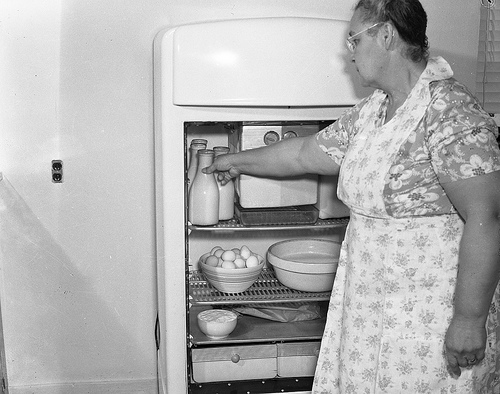
Speaking of refrigerators (I’m hoping Jessica will keep coming back, because I loved her response), I enjoyed some of the words and expressions in this AmE ad from the 50s. Have a listen. Are there any you especially like too?
American readers, please help me out and correct me if I’ve got stuff wrong here. I think ‘Jeepers’ is long gone from AmE (along with others like ‘swell’ and ‘holy mackerel’ – shame, eh?) And probably ‘Boy, oh boy’ too, though I’m less sure about that.
‘Gee’ is interesting. I’ve heard it occasionally, so I think that while it’s less popular it’s still lurking. An expression that isn’t in the video that I’ve definitely heard is ‘Yes, indeedy’. I don’t know if it’s a Philly thing and I don’t hear it that often, but when I do, it always makes me grin. It packs such enthusiasm. Which brings me to something else that struck me in this video: the use of the word ‘sure’.
That sure is.
Sure, Pop.
We sure can.
I think these would all work today so I’m guessing these ‘sure’ uses seem to have endured the test of time in AmE. So what’s the implicature ? In semantic terms, sure‘s meaning is tied up with certainty, but in pragmatic terms, isn’t it more about enthusiasm or willingness? I ask because I think it might be a good example of the limited meaning we might be teaching if we choose to focus on semantics alone.
I’ll certainly be coming back if you keep feeding my fridge obsession in this way.
On a language note, don’t you think that ‘jeepers’ has been forever immortalised by Velma in Scooby Doo. While it may not be used in everyday interaction it crops on TV as a knowing, self-referential wink to the audience. Wasn’t there a Horror film franchise called Jeepers Creepers? I don’t think it’s going out of fashion, just moving to a different realm of usage.
By the way, I heard an American tourist in the Barcelona aquarium the other day use ‘Holey Moley’ and I thought that was a language dodo!
[…] This post was mentioned on Twitter by Karenne Sylvester, ozge karaoglu and Nick Jaworski, Russell Stannard. Russell Stannard said: RT @kalinagoenglish: via @vickihollett We sure love refrigerators #beltfree […]
I have a friend here in France who comes originally from Seattle and she will often say boy oh boy, holy mackerel AND jeepers – most times in the same sentence!
But she will NEVER say Frigidaire, and i’m sure about that.
Yep, “sure” sure is about enthusiasm and giving the other person a sign that you’re backing them up 101% 😉
Not to forget “sho ’nuff!”
Not sure about “holy mackerel” being out, I’d put that in the category of stuff we say to be comic anyway. http://holymackerelseafood.com/
I’m trying hard to lose “okie dokie”, but it keeps popping out.
Well, holy moley, I’ve had an idea that could speed up my acculturation process and be a lot of FUN. Jessica, Chris and Anne, thank you! I’m gonna try peppering my speech with real swell, jeepers, gee whizz, and the like. It’s bound to amuse (me if not others). I’ll let you know how I get on.
I definitely think there are still pockets of the US using some of these expressions, at least in the South. I’m from Texas originally and went to college in the North East. Despite not having a noticeable Texan accent, my “weird” expressions were constantly remarked upon by my classmates in my first year.
You know “y’all” of course, which I’ve since managed to drop, but I still say “gee whiz”, “gosh darn it”, “goodness gracious”, “oh my goodness”. Some more I don’t use but know to be in very frequent usage in Texas:
“bless his/her heart”, “well I’ll be”, “now isn’t that something”, “holy smokes”, “jimeney cricket”, “you don’t say”
Oh my, Kate. You have just increased my entertainment value no end with these gems. If I pepper my speech with these, should be able to dine out on them for weeks.
Minced oaths were a mark of U.S. culture up until about 1965. They have mostly been replaced with their stronger counterparts: those who would carefully have said darned in the old days, will now come out with damned in the same circumstances, and jeepers, gee whiz, and jiminy cricket have for the most part been replaced by Jesus (Christ). That said, in general older expressions last longer in the South than elsewhere.