Vicki

Teacher of professional and technical English, writer and teacher trainer.

Oct 312010
 

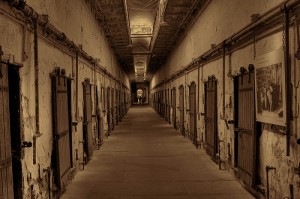
One place I will NOT be visiting this Halloween night is the Eastern State Penitentiary. But I recommend you go if you can. When it was opened in 1829 it was the most expensive prison in the world and it quickly became the most famous. People like Alex de Tocqueville and Charles Dickens travelled from afar to see it. It was a Quaker institution and no expense was spared to help the inmates reflect on their sins and repent their wicked ways.

Eastern State PenitentiaryThe inmates had central heating, showers and baths in their private cells. They had flush toilets – this at a time when even the prison governor didn’t have a flush toilet. They lived in complete isolation in their cells receiving their food from the guards through a small feeding hole. They had just a Bible to read, and some work like shoemaking and weaving to pass the time. I gather slowly but surely, quite a few went insane. The pressure on space meant prisoners started sharing cells in 1913, and by the time Al Capone became a one of inmates, prisoners were working together and even playing organized sports.

The place was shut down in 1971 and it’s a museum today. Each Halloween it becomes a living museum where actors don costumes and make up and take on the parts of guards and inmates. You have to sign a waiver saying something like ‘I promise not to sue you if you give me a heart attack’ and the rules are explained at the start. Basically they are ‘no touching’- so they won’t touch you and you can’t touch them, but apart from that anything goes.

It’s terrifying. You’re stumbling around the dimly lit, crumbling 11 acre site, petrified at what waits around every corner. They’ve got the timing down to an art form, so just when your heart palpitations subside they’ve dreamt up a new horror. I jumped out of my skin when an inmate roared at me. ‘Calm down, Vicki’, I thought. ‘He’s behind bars’, but the next second he’d bent the bars and his face was two inches from mine. Hitchcock couldn’t do it better.

I think it was ranked the sixth scariest place in America when we took the Halloween tour a few years ago. I dread to think what the ones deemed more scary were like.

So in our house, we have:

  • a pot with a green hand that reaches out and grabs you if you try to take a sweet/candy.
  • a device we hide under the doormat that shrieks when you stand on it.
  • Frank – a three foot high Frankenstein monster who launches into a growl and rock song when his light sensitive eyes detect your approach.

That’s plenty for me.

 Posted by at 11:28 am
Oct 242010
 

I knew I was back in the US when a neighbour greeted me with ‘Hey travelling girl’ and proceeded to tell me about a new activity he’d taken up – disco bowling. Now, there’s a combination for you. One of the things that’s slowly dawned on me  is that the American pursuit of happiness might be better described as the pursuit of fun. No, let me restate that – the pursuit of FUN – because I’m talking about fun in a big way.

Some Americans have rooms in their houses devoted to recreation. We lived in living rooms in the UK, and dined and dining rooms, but I don’t think I ever came across a British rec room. I met an American on my travels and asked her what she missed most about home. ‘Playing’, she said and I knew what she meant. Americans seem to have some kind of special facility for it.

Jousting
On a trip to Orlando, we once checked ourselves in for a dinner and joust – yep, a real live joust with medieval knights on horses. I use the term ‘medieval’ very loosely though. The 13th century event took place in a 20th century cement block structure, the horses performed to early 19th century Strauss waltzes and the battles were enacted to the theme music of Ben Hur (circa 1957?). The location had me foxed as well. The building was decorated with the names of Spanish towns but the MC spoke in a quasi-British accent and the horses looked like they’d come straight from Vienna to me. And then I realised it was pointless to be troubled by these questions. Nobody else was, and heck, they were irrelevant. I had to be in 21st century America because nobody around me was allowing any historical or geographical facts to get in the way of having a good time.

So all in all, it’s very nice to be back in the US and if anybody wants to invite me disco bowling, I’m ready to play. And if you’d like to combine any other pursuits as well, like glass-blowing-on-roller-blades or karioke-skydiving, I’m prepared to give it a whirl – just so long as you think it might be FUN.

 Posted by at 6:41 am
Oct 202010
 

No doubt you’ve noticed. Lots of the baddies in American movies are Brits.

And if it’s passed you by, think of the villains you’ve seen in American movies – the best ones were British, weren’t they? The Matrix Reloaded, Mission Impossible, The Bourne Films, Spiderman 2, Catwoman. Oceans 12 and 13, and who could be more evil than Anthony Hopkins as Dr Hannibal Lecter? Then there are the baddies in Mel Gibson’s films, but let’s not bother going there. Thing is, cast a Brit as the evil-doer and you raise your odds of having a blockbuster hit.

So I’m wondering, what is it that gives British actors the edge as villains in ‘merican movies?

I just watched an oldie – Wall Street – and there’s a line in it where Gecko comments on some British Lord who’s visiting NYC.  He  says, ‘Like all Brits, he thinks he was born with a better pot to piss in.’ So I’d hazard a guess that arrogance and aloofness are key. And to build my case, someone who once employed me here commented later that he was relieved to find I was willing to ‘muck in’. ‘Why did he think I wouldn’t?’, I wondered. So I’d  wager that a key trait associated with Brits is unwillingness to join in achieving a common goal.

And what is it exactly about us Brits that exudes our baddy aura?  Is it just our accent or our British visage, posture, eye contact, clothing, dental work or something?  Or is it stuff in our speech patterns, turn taking styles, how we structure our thoughts etc. that makes us seem unhelpful and aloof. I think differing US/UK styles of politeness are playing a large role. We’d rather appear standoffish than intrude.

And one last point about this. I don’t think Brits give a hoot. Cast us in baddy roles and we find it pretty amusing. But perhaps I’m wrong about that, so let me ask: fellow Brits, does the frequent casting of Brits as evil-doers offend you, or is it water of a duck’s back?  (And if it’s the latter, might that also signal arrogance and aloofness somehow?)

 Posted by at 12:51 am
Oct 182010
 

want too by celticsaga.

I’m back!

A while ago Darren Elliot raised a very interesting point on this site here. He pointed out that foreigners in Japan will often be lavished with compliments for being able to use chop sticks. This happened to me stacks of times when I lived in Japan. You mean, it wasn’t because I was stunningly deft with them? (Only kidding)

By: pulaw

I have a friend who was complimented in China on how fat he was looking. He was a little disconcerted. So I’m wondering, have you ever received any compliments in your travels that seemed a tad odd?

 Posted by at 12:54 am
Aug 142010
 

I’ve been arguing that ‘sarcasm’ means different things in BrE and AmE, so is it the same with ‘irony’? I’ll try to be systematic about this because there are different kinds of irony.

1. The most common sort seems to be of the verbal kind. An example would be a sarcastic remark where you say the opposite of what you mean, like ‘Yeah right’ when you mean ‘No way’. And we generally all know that you mean ‘no way’, so it’s often funny. These kinds of remarks seem pretty common on both sides of the pond to me, and we could use the word ‘ironic’ in both varieties to describe them.
2. Then there’s fictional or dramatic irony, so when something is strikingly obvious to the reader or viewer but the characters or actors can’t see it. It’s pretty specific to literature and there might be a BrE /AmE difference, but if there is, I haven’t noticed it.
Irony

3. And then there’s a situational irony, where instead of things happening as expected, we get the opposite result. This irony is often of the cosmic kind, where the world seems to be conspiring against us. So we might set out with the best of intentions doing what seems sensible to achieve a goal, but it later turns out that we did everything wrong and we wind up achieving the opposite effect. (I keep thinking of Del Boy in ‘Only fools of horses’ setting out to help Rodney mend his marriage and only making matters worse.) Again, I think we use ‘ironic’ in the same way for this in BrE and AmE.

‘But what about Alanis Morissette?’, you ask. ‘Did she misunderstand the word when she wrote her song ‘Ironic’?’

Yes, I think she misunderstood meaning No. 3.  The events she describes wouldn’t normally be described as ironic in AmE. (You’d agree, wouldn’t you, American readers?) As the Irish comedian Ed Byrne puts it:

“The only ironic thing about that song is it’s called ‘Ironic’ and it’s written by a woman who doesn’t know what irony is. That’s quite ironic.”

Here’s Ed in action. (Thanks very much for the link, Shaun!)

So I reckon:

     ‘sarcasm’ – different meanings in the UK and US
  ‘irony’ – same meanings 

Mind you, I read something that gave me pause for thought at this site ( I’m guessing it’s AmE.)

The word “irony” is among the most commonly misused (and misunderstood) words in the English language. Most people think that irony means a juxtaposition of opposites, as in:

• It was ironic that the fire station burned down.

While this sentence has some element of irony in it, it is not really ironic, and does not portray the full and correct meaning of the word irony. True irony involves some form of deceit, duplicity, or hypocrisy, be it intentional or accidental... …

The most common form of irony is when the spoken words do not convey the underlying meaning. For example, it would be ironical for you to say:

• He is as smart as a soap dish

Well, this was news to me because I found that fire station example pretty ironic and the soap dish example very un-ironic. So maybe it’s another individual’s misguided take on things, or perhaps I’m missing something here.

Any thoughts?

Here’s the rest of this series: part one, part two, part three

		
 Posted by at 5:25 am