Vicki

Teacher of professional and technical English, writer and teacher trainer.

Aug 062010
 

There are times when I really wish I could put on a good American accent here. Like at the Philadelphia Parking Authority the other day – I’m pretty sure the woman could have understood what I wanted if she’d just been a little more patient. But some kind of invisible wall descended between us when she heard my accent.

When my son was a toddler, he used to enjoy singing ‘Oh what a beautiful morning’ from the show Oklahoma. And the weird thing was, although he was British, he sang it with an American accent. How come?  So I was fascinated to read here that an ‘merican accent might be the default setting for singing.

Ha! Well who’d have thought! The next time I need guest parking permits, perhaps I just need to burst into song!

For an accent story that always makes me giggle, see Chris’ comment on buying paint in the US that he posted here.

 Posted by at 6:12 am
Aug 032010
 

I’ve noticed that it seems to be fine to make a lot of requests when you’re ordering food in the US. Sally (Meg Ryan) provides a demonstration of how to do it here (starts at 8 mins 17 seconds in – ends at 8 mins 51).

(Ah sorry folks! Since posting this, the video has disappeared from Youtube. It was that scene where Sally was being very precise and picky when she was ordering in a restaurant)

Ha! Well, being a picky customer is not totally OK here of course, but it does seem to be more acceptable than it might be in the UK.

Nevertheless, when I’m playing host, I’ll want to offer my guests say eggs for breakfast – so it’s ‘Boiled, scrambled, easy over, or sunny side up?’ And once those choices have been made, would they like soft or hard, dry or runny?  Then we start on how they’d  like their toast and bacon. There are a lot of decisions to be made, and the day hasn’t started yet.

Compare this with Japan where, as I understand it, it’s the host’s task to consider what’s most likely to please their particular guest, and place it before them. The guest will exercise ‘enryo’ (restraint, reserve) about expressing their individual preferences, which has some attractive benefits. With life’s small decisions lifted from their shoulders, their only responsibility is to settle back and enjoy.

Sheena Iyengar has done research into differing cultural attitudes to making choices. In this delightful TED talk she presents some interesting angles on the pros and cons of living life a la carte, along with some entertaining anecdotes.

 Posted by at 9:48 am
Jul 302010
 

First a question:

Remember Bob Geldof, Boomtown Rats singer and oh so earnest political activist of Live Aid fame?  He’s sometimes referred to in the UK press as ‘Saint Bob’. Would you say British newspapers are being sarcastic when they do that?

OK, done that? Remember your answer and read on.

So where were we?

Well, in part one I said that in BrE, we describe remarks as ‘sarcastic’ when we’re saying the opposite of what we mean. Meanwhile in AmE, ‘sarcastic’ seems to cover a wider range of remarks, such as those you’d find here or here. They mostly wouldn’t qualify as sarcastic in the BrE sense, but I think AmE readers seemed to agree that they would in AmE. However, reading comments from fellow Brits, I’m still wondering if I’m defining BrE sarcasm too narrowly.

So now I need to tell you that someone very knowledgeable has come to the exact opposite conclusions to mine.  Ha! You can read more about it over at Lynneguist’s excellent ‘Separated by a common language’ blog. Solo was one of Lynne’s students, and she wrote:

Over the course of my research into the differences between American and British (especially English) sarcasm …, it became clear to me that the difference isn’t so much in the way we use it, as in the way we define it. While the AmE definition emphasi{s/z}es negativity and saying the opposite of what is meant, Brits seem to have a far broader definition, which includes humorous exchange, clever wordplay and affectionate insults or criticisms of others (even those we don’t know, which I think may be the most fundamental cultural difference).

Co-op First Aid Dressing Launch - Page 1 by damo1977.

Solo gives an interesting example:

…there are things we British will do in conversation which we would call sarcastic, but which Americans would not. For example, in the irreverent media, Sir Bob Geldof, of Live Aid fame, is frequently referred to as ‘Saint Bob’. Now this is obviously not entirely sincere, but it isn’t fully contemptuous either; we are mocking his interminable altruism and campaigning, but we also respect all his charity work and dedicated parenting. So although we don’t completely mean that he is a saint, we also don’t mean that he isn’t and I think most Brits would refer to that as sarcasm, but I’m also fairly sure our American counterparts would not. Feel free to correct this flagrant generali{s/z}ation ☺

So Brits and Americans (and everyone else) how did you answer that question earlier?

I’m sure Solo’s right that ‘sarcastic’ means different things in BrE and AmE. But I wonder if we’ve both been going up the wrong garden path here. We’ve both tried to apply that ‘saying-the-opposite-of-what’s-meant’ definition to one variety or the other. But it’s very limiting and probably only works in part in both varieties. And we’ve both presumed that one variety encompasses a broader set of meanings for sarcasm than the other. But a more helpful way to think about it might be something like this:


Click here to read part one of this series and here for part two.

 Posted by at 6:36 am
Jul 292010
 

A wink & a nod by kthypryn.

An overt nod and a wink seems to be used a good deal to signal sarcasm in the US. I ran searches on my personal emails and I can tell you that only my ‘merican correspondents ever say ‘just kidding’.

And (interestingly for this Brit) this extends to ‘mericans who are really close to me – folks who I feel sure must know that I know when they’re making fun. They don’t flinch when I mock or tease them and they give as good as they get. But when we’re trading friendly, intimate insults, they add a ’just kidding’. So what different politeness rules are operating here?


Big, big thanks to the perceptive commenters who highlighted this when I was trying to tease out the differences between the US and UK meanings of sarcasm in part one of this series.

 Posted by at 9:31 am
Jul 252010
 

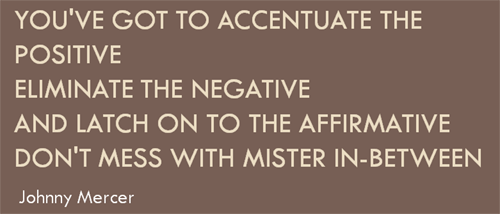
When we turn on the news in the morning, we see upbeat, perky news commentators who greet us with happy smiles and cheerful laughter. This is despite the economic meltdown, the vast numbers of unemployed, the BP oil spill, hurricane season starting etc, etc. It seems the sentiment of this old song is still flourishing in the US.

A positive attitude is generally valued on both sides of the Atlantic, but I think it’s more prevalent and deemed more important here. I sometimes hear Americans self-monitoring and saying, ‘Now how can I say that more positively?’ And something similar often goes on in my head when I’m trying to translate my British thoughts into ‘merican. Eliminating the negative, or at least toning it down, is often a big part of the restructuring.

There’s a book called Brit-think, Ameri-think by Jane Walmsley in which she entertainingly maintains:

The single most important thing to know about Americans – the attitude which truly distinguishes them from the British, and explains much superficially odd behavior – is that Americans think that death is optional. They may not admit it, and will probably laugh if it’s suggested; but it’s a state of mind – a kind of national leitmotiv if you like – that colors everything they do. There is a nagging suspicion that you can delay death (or who knows? avoid it altogether) if you really try.

Well, daft as it sounds, maybe there’s some sense in thinking that way. After all, positive thinking can have some surprising benefits, as some researchers at the University of Cologne recently discovered. They took a group of golfers and told half of them that they were going to use a lucky ball. The other half were told nothing. Can you guess which group performed better on the putting green? Yep – the ones who thought they had luck on their side. It’s not first time this sort of effect has been observed and it’s led psychologists to suggest that optimists might approach life with a positive frame that makes them more open to spotting opportunities, and hence they really do become ‘more lucky’.

So how far should we engage in positive thinking? Should we all start pretending that death is optional, for instance? Jane Walmsley maintains it’s the secret of America’s fundamental optimism, but she also goes on to point out the downside:

Your life is in your own hands… and the quality of that life as well. You owe it to yourself to be beautiful, clever, skinny, successful, and healthy. If you fail it’s because you’re not trying hard enough… (you didn’t jog regularly, you should’ve eaten more bran). Death becomes your fault.

There’s a terrific video below in which Barbara Ehrenreich also explores the downside of positive thinking and argues instead for a hefty dose of realism. Very interestingly, she points out that a requirement to ‘think positive’ can operate as a form of social control. When cheerful optimism is mandatory, people who foresee problems get told to shut up or get fired. And if we imagine that problems like extreme inequality, discrimination or poverty can simply be fixed by individual victims ‘thinking positive’, it removes the pressure to solve them.

Barbara is American, and she’s talking about the dangers of positive thinking in the US. But I think a lot of what she’s saying relates to the UK and elsewhere as well. Any thoughts?

(Many thanks to Karenne Sylvester for sending me that great video link)
 Posted by at 11:25 am