Vicki

Teacher of professional and technical English, writer and teacher trainer.

Jul 232010
 

Just a quick note to say Macmillan invited me to describe my key struggles with ‘merican over on their English dictionary blog where they have been having a ‘merican English month. They’ve had some terrific posts on the subject from different writers. To read mine, click here.

 Posted by at 7:42 am
Jul 192010


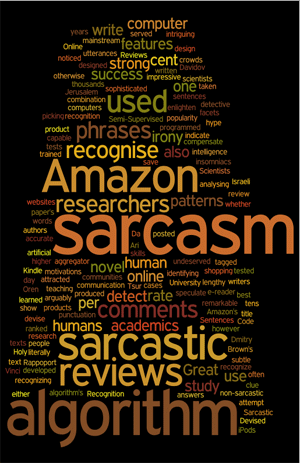
I’ve just read here that researchers have devised an algorithm that can detect irony in long texts. Wow! Robots can detect sarcasm!

Apparently they ‘trained’ the algorithm by giving it a long list of sarcastic phrases from Amazon product reviews. Now were they detecting British or US sarcasm, I wonder?

‘Sarcasm’ is a tricky concept for a Brit in the US. Popular wisdom amongst Brits is Americans don’t get it, and popular wisdom amongst Americans is it’s ‘bad’. Yet I seem to find myself surrounded by it here. So I thought I’d stick my neck out and have a stab at describing what I think it might mean in the two varieties. I’m still learning, so Brits and Americans, please put me right if you think I’m off target.

In BrE, I think we generally describe remarks as ‘sarcastic’ when we’re saying the opposite of what we mean e.g. ‘Wow, that’s a surprise’ when something was very predictable, or ‘Nice weather, eh?’ when it’s pouring with rain, or ‘Punctual, as always.’ when someone who always comes late finally arrives. So sarcasm can be either nice (a funny joke) or nasty (an unkind remark) but some element of ‘saying the opposite of what you mean’ needs to be involved for something to be labeled sarcastic.

Take a tour round some American websites like this one or this one and you’ll find remarks that wouldn’t qualify as sarcastic in this BrE sense. Nevertheless they’ve been labeled ‘sarcastic’ by American writers. So ‘sarcastic’ seems to be used to describe a wider variety of remarks in AmE– some saying the opposite of what’s meant, but many not. Depending on context, sarcastic seems to mean something closer to ‘unkind’, ‘insulting’ or simply ‘funny or amusing’ here.

Now fellow Brits, I need your help with this – am I defining British ‘sarcasm’ too tightly above? Are there BrE ‘sarcastic’ remarks that don’t fit the ‘saying the opposite of what’s meant’ rule?

And consider this example:

Bill Bryson tells a story of a return to the US after he’d been living in the UK for many years. I can’t remember it exactly, but as I recall the agriculture police guy asked ‘Any fruit or vegetables, sir?’ and he quipped back something like ‘OK, I’ll have half a pound of carrots and a couple of pounds of potatoes.’

Could you describe Bill’s quip as sarcastic there? And Americans, what do you think?

 Posted by at 10:39 pm
Jul 082010
 

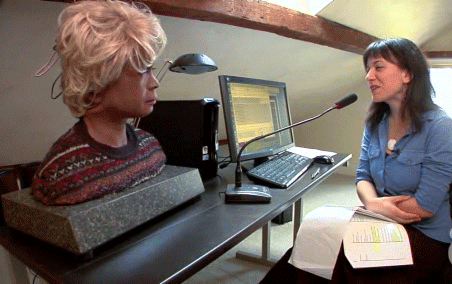
I recently wrote about ‘What is pragmatics?’, but perhaps it’s best explained by what it isn’t. I think pragmatics is probably why this conversation doesn’t work. But what makes it go awry – or more specifically, what is it that this robot can’t do?

Click here to watch the video and enjoy!

PS

I made such a poor job of this post the first time, I thought I’d better add a big PS and have another go!

A lot of the meanings we transmit and receive in conversation are hidden or secret because they’re not decipherable from the just words we use. They get transferred via context and shared understandings about what’s relevant and appropriate. Grammar and semantics are important –

really important – but they have their limits. And a great place to see where the limits lie is robots.

By robots I mean the answerphone machines that greet us and try to decipher where to route us when we call large companies, and the avatars we meet around the web like IKEA’s Anna, and robots like the one in the video above. These robots often have us pulling our hair out, crying out for an ‘agent’, ‘operator’, representative’, ‘human being’ or whatever. But actually, if you think about it, human beings often have us pulling our hair out too.

And robots are getting pretty sophisticated these days, Speech recognition software has come on a bundle and a lot of grammar and semantics is programmable. But while they can recognize the words, they only work up to a point. I reckon they have mostly been programmed for grammar and semantics – because they are the easy things to program. If they aren’t programmed to grasp the hidden meanings we work with, they’ll never pass the Turing test. Use a metaphor, for example, and things are likely to go caput.

So I was thinking that’s what pragmatics is about: the study of the secret meanings. And so what pragmatics isn’t about is the study of the stuff that that robot in the video has been programmed with.

 Posted by at 5:53 am
Jul 042010
 

Someone asked me the other day, ‘Do you celebrate the fourth, Vicki?’ Well, actually that’s a very good question.

Obviously, like all Brits, I view the Declaration of Independence as an act of treason. And yes, I’ve listened to the ‘no taxation without representation’ excuses, but what about the fact that the poor British taxpayer had to cough up to defend Americans in their French and Indian war? And once saved, would they chip in? So I ask you, where’s the gratitude?

So it’s going to be tough because it’s hard to escape the 4th when you’re living in the middle of Philadelphia where it all happened. I’ll be forced to contemplate the sorry events of 1776 with my significant alien and friends who will be partying on the deck tonight. I expect the weather will be gorgeous as it usually is on the fourth, but fortunately we Brits are made of stern stuff. No doubt I’ll manage to maintain a stiff upper lip as I tuck into thetraditional barbecue feast. And then I’ll have to suffer through the very best firework display in America.

DSC_6182 by lindseywb.

So it’s a tough life, but as we say where I come from, mustn’t grumble.

Here’s wishing American’s everywhere a spectacular fourth of July.

How will you/did you celebrate?

 Posted by at 12:01 am
Jul 022010


Pragmatics is a relatively young branch of linguistics and basically it’s about the way we get meaning from context to understand people’s intentions – or not, of course – but it’s not a simple thing to define.

George Yule memorably described it as the study of ‘invisible meaning’ because it’s not about the meanings we get from syntax or semantics. It’s more about the relationship between the linguistic forms and the users of the language. So anyway, I chuckled when I read Laine Cole’s anecdote over at the Macmillan Dictionary Blog (where they have just started running an American English month – very exciting!) She has illustrated it perfectly. Laine grew up in South Africa and her story goes thus:

I once shared an office with two Britons and an American. We all started work at more or less the same time and we were all just getting to know each other. One day my new American friend took me aside and said: ‘Do you understand what those two are saying when they speak?’ ‘Yes’, I replied, ‘But maybe it’s because I’m more used to the British accent’. ‘No’, he said. ‘It’s not their accent. It’s that they don’t seem to say what they mean’.

Ha! No wonder learning to speak ‘merican is hard for this Brit. And it reminded me of my favourite definition of pragmatics. I’m afraid I’ve no idea where it comes from, but it goes:

“PRAGMATICS IS THE STUDY OF HOW WE DON”T SAY WHAT WE MEAN”

Many thanks to Macmillan Dictionary Blog for the anecdote and also for including my guest post on ‘The trickiest word in American’ today

 Posted by at 12:56 am