Aug 162012
 

Just a quick post to pass on  a lovely bit of google autocomplete research (discovered via @LarryFerlazzo) about what Americans think of other states. You can hover over a map and see what the top autocompletes were for “Why is [state] so…..

It prompted me to do some similar research for Philly (where I live). “Why is Philadelphia so…” resulted in:

  • disgusting
  • damned dirty
  • resistant to modernity
  • significant
  • centered on traffic engineering when it is one of the great walking cities in the world

I’ve grown very fond of Philly, so I felt out of synch with the stereotypes – except the last one. I’ve often wondered about that myself.  Why do we have freeways carving through the streets making it hard for pedestrians to cross? The priorities seem curious, if not awry.

I’ve stopped driving since we moved to the city, like many other residents. Apparently 44% of my center city neighbors walk to work – the highest rate in the US. I don’t know how that compares with other countries, but I’d have thought that was a pretty high rate for any city center in the world. Does anyone know?
 

 Posted by at 6:15 am
Aug 112012
 

I’m a huge fan of Lynne Murphy’s blog: separated by a common language where she delves into all sorts of interesting differences between British and American English. I’m also a huge fan of TED videos, and obviously I’m interested in linguistic politeness and British and ‘merican – it’s what this blog is about.

Well guess what! A TED talk by Lynne on linguisitic politeness and British and ‘merican has just arrived on youtube. Hurrah! Enjoy!

 Posted by at 10:09 pm
Aug 022012
 

Wehey! Learning to speak ‘merican is back on line! 🙂 Thank you all for your patience. In fact what’s happened here is it has split into two blogs. You’re at the one about pragmatics and sociolinguistics here and there’s another one for teaching issues. Both site feeds should work now, but you will need to do an update because I’ve had to change the address. Please check the side bar for details.So where were we before we got disconnected?  Ah yes, politeness.

There’s an interesting feature of politeness that, for want of a better term, I generally call “the prick factor’. The thing is, if you call someone else a prick, it’s very likely that’ll you’ll wind up looking like a prick yourself.

In simple logic it shouldn’t work that way. If you put someone else down, it should show how much better than them you are, and so enhance your standing. But politeness operates to much more subtle rules than that.

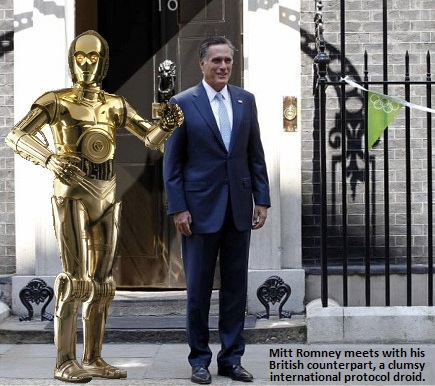
Mitt Romney illustrated what a pesky problem it can be in London earlier this week when he lectured his British hosts on their security.  It must have seemed like a golden opportunity to remind everyone that he had  “saved” the Salt Lake City olympics. But instead it wound up with him being dubbed ‘Mitt the Twit’ by the Sun and spawning pictures like the one top right on the web.

I’m not sure how most Americans will have interpreted the incident. My guess is the rudeness and his too-little-too-late-back-peddling won’t have passed unnoticed. And of course it’s damaged his international reputation, but actually I don’t think many Americans will care much about that.

Another thing I’m still wondering about is what did Americans make of the celebrations of the National Health Service in the opening ceremony? Did it seem odd to be celebrating ‘socialized medicine’, as its known here?  Oh and what did y’all think of the opening ceremony?

UPDATE!

Duh, I forgot. One of the other reasons I wanted to write about the Olympics was because I wanted to share this article on British politeness from the Guardian. Enjoy!


 Posted by at 3:04 am
May 022012
 

I’ve mentioned before that something that used to surprise me is that when that an American sees a random person walking along the street, they’re quite likely to ask, ‘How are you doing?’ This is someone they don’t know and who they’re unlikely to meet again. Aside from the intrusiveness of the question, do they really want to know?

Foreign visitors are often surprised by American friendliness too. ‘Is it fake?’ they ask. I don’t think so. I think it’s rather like a Tagalog speaker who greets people with ‘Where are you going?’ expecting the answer ‘Over there’; or a Taiwanese speaker who greets you with ‘Have you eaten yet?’, when they have no intention of inviting you for a meal; In China, a greeting might go ‘Old Zhang, are you busy today?’ Rather than ‘Less of the old, please’ the standard response is ‘Very busy’ or ‘Not very busy’. What we’re looking at here are rituals, procedures we all follow without thinking about them.

The ritual for greeting a passer-by is different in the UK. As a rule, we don’t. It’s not that we want to be unsociable but they might be engaged in their own thoughts and we wouldn’t want to intrude. Should something embarrassing happen, like our eyes accidentally meeting, a brief nod or ‘Morning’ enables us both to swiftly pass on.

The British non-intrusion approach and also operates when we’re at an event like a party, even though everyone knows the purpose for being there is to socialize. After fortifying ourselves with a couple of glasses of wine, we might signal our willingness to talk by passing a comment on the weather, or food or something happening in the room at the time. But we haven’t yet mastered the art of going up to strangers, sticking out our hand and saying, ‘Hi I’m Vicki from Pennsylvania.’ I was astonished with the aplomb with which Americans handled that when I came here.

Another similar post on farewells: http://www.vickihollett.com/?p=1406


 Posted by at 12:30 pm