Apr 112012
 

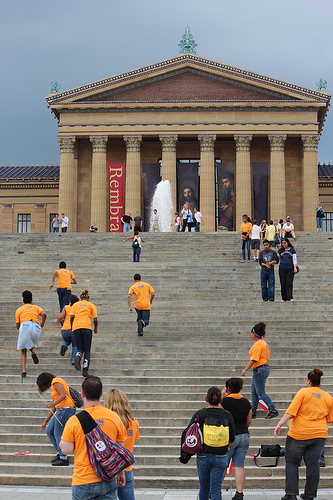
If you visit Philadelphia (as many English teachers did last week for the TESOL conference), a ‘must do’ activity is to run up the 72 stone steps in front of the Art Museum.

Why?

Well, it’s a sort of ritual re-enactment of a classic scene from a ‘Rocky’ movie. For those who haven’t seen it, it’s about a downbeat boxer (Sylvester Stallone) who’s run to seed and given up on life. He decides to get back in the swing and get fit, so near the start we see him huffing and puffing when he tries to run up the steps. As he gets fitter, so it becomes easier.

It turned out to be a doddle for my friend and fellow Business English teacher, Evan Frendo too. Bravo Evan! You can see him in action here:

Some other stuff about the Rocky statue and steps:

  • You get a terrific view of the Bejamin Franklin Parkway and City Hall from the top of the steps – definitely worth the climb.
  • We’ve found the Art Museum steps are great place to make vox pop movies because people from all over the world come there, and they’re generally in a good mood and have time to talk to us.
  • The statue of Rocky is a big tourist attraction but its location has been a source of controversy. It was a prop in the movie Rocky III in which it was positioned at the top of the steps. Stallone donated to the city after the movie and some say he expected them to leave it where it was. But it was immediatly moved to the sports stadiums in the south of the city by the Philadelphia Art Commission, which didn’t consider it art. However this wasn’t good for tourism. After twenty years of wrangling, a compromise was reached and it’s now positioned at street level, to the right of the Art Museum steps.
  • There have been lots of parodies of the movie scene in ads and TV shows like the Simpsons.
  • The movie was made at a time when they’d just invented steadi-cams – cameras that you could carry and still keep shots relatively steady and smooth.  Just as well with 72 steps, eh? The camera was invented by a Philadelphian cameraman called Garrett Brown.
  • Syllvester Stallone plays an Italian American from South Philly in the movie so he greets people with ‘yo’ and uses the plural  form of ‘you’ -‘yous’. Many Philadelphians looks on him as one of their own, but actually he’s a New Yorker.

You can see the original movie scene with Rocky running up the Art Museums steps here:
http://www.youtube.com/watch?v=NubH5BDOaD8

 Posted by at 10:20 pm
Feb 222012
 

When I first moved to the US, many things struck me as curious. Amongst them:

  • How come are there so many American flags flying from buildings?
  • Why is burning a flag a big issue here?
  • Why does the word ‘American’ appear so often in advertisements?
  • Why do people refer to  “Japanese Americans”, “African Americans”, “Italian Americans” etc, etc ?
  • Why is the national anthem played at the start of many public meetings?
  • Why do people put their hands on their hearts when it’s played?

Am I living in a land of wild patriotic fervour, I wondered. A close friend became an American citizen recently and invited us along to her naturalization ceremony. It helped me understand. For most of us, our nationality is an accident of birth. But when you consciously choose your citizenship, it becomes a much more meaningful state of being. A big thank you and many congratulations to Geri!

 Posted by at 12:54 am
Jan 182012
 

‘Roast’ is an American term used to describe a heartwarming ritual where someone is singled out and publically subjected to a stream of funny insults from their friends and peers at some event – usually some kind of ceremonial dinner. We don’t use the term ‘roast’ in the same way in the UK, but the ritual is not unfamiliar. A British best man’s speech would be a prime example. And on both sides of the Atlantic it’s understood that the ritualized insults and embarrassing revelations can actually demonstrate fondness, affiliation and somewhat contrarily, respect.

In both the UK and US, the person being ‘roasted’ is required to take the jokes and insults with good humor. In fact taking the jokes in good part is actually an opportunity for them to demonstrate what a good natured soul they are, and thereby gain more esteem. However, there are some transatlantic differences. US roasts include more praise and tributes. And in the UK, where ambiguity is rife, the jokes are allowed to be more barbed and vicious.

When I heard Ricky Gervais hosting the Golden Globe awards last year, I thought “Uh oh, this ‘roast’ is pitched this wrongly for this audience.” What is acceptable in London can easily go over a line in LA and his reviews weren’t good. But he was given another go at it this year so I guess there’s no such thing as bad publicity. I think he’d been well coached in the interim and he was more on target this year. His most vicious jibes were reserved for British actors, who he could be sure would play by his rules and show no offence.

But I have a question about this year’s award ceremony. To me it looked like the recipients of Ricky’s jibes seemed to have prepared responses which I found odd in various ways. Did you think the same? I’m wondering what other folks made of this.

(Ah, what a shame! Since posting the video it has been removed from Youtube. – sorry folks!)

 Posted by at 5:01 am
Jan 032012
 

I never gave much thought to tipping when I lived in the UK. It was (an easy to add) 10% for taxi drivers, hairdressers, and waiters/waitresses (if something hadn’t already been added to the restaurant bill). Poor service – round down. Abysmal service – no tip. Good service – round up. Great service – add a bit more. Oh and perhaps buy a pint for your favourite barperson at the pub, but that would be very unusual. The thing was, in my mind, the amount I gave was linked to the level of service.

That’s all gone out the window in Philly. Keep us waiting, be surly and mean, spill our food and drink all over us – no matter what you do, you’re going to get a 20% tip. Many service employees are paid minimum wage here. They live on tips. Plus some taxing authorities assume they’re getting about 12% extra – so if you don’t tip, they’ll wind up paying for the pleasure of serving you. Argh!

In some countries tipping is rare or very minimal. It might be viewed as “showing off” or even insulting. ‘You don’t think I’d give you good service anyway?’ ‘You think I’m hard up?’ So the US can be tricky place for foreign visitors. And if folks are like me, and come from cultures where the tip amount is related to the quality of service, this place is going to seem crazy. Here’s a helpful video about the complicated rules of ‘merican tipping.

So how much do you tip?

 Posted by at 3:05 am