Jan 012012
 

Wishing all ‘Learning to speak ‘merican’ readers all good things for 2012. Thank you for all your great contributions this year. I have lots of ideas for 2012 and do hope you’ll keep coming back and sharing. I think it’s going to be a great year!

I love watching the ball drop in Times Square, but I also adore London’s fireworks. Hope you like them too.

Ah, what a shame! Since posting the video of the fireworks it has been removed from Youtube.

Happy new year!

 Posted by at 7:18 am
Dec 052011
 

By: Jinx!

It’s not always clear to me what is and isn’t politically correct in the US, so I’ve given my American husband some uncomfortable moments. He still winces when he remembers the time I complimented our gay friends on their fairy lights. (“But that’s just the word we use for holiday lights in the UK.” “Yeah, but Vick….”)

And without sharing the same history, I think it’s hard for Brits to see why using the adjective ‘niggardly’ should cause controversy. It simply means stingy or mean to us, and we’re insensitive to its phoenetic similarities to racial slurs.

But it seems Brits can go in for a pcness all of they’re own. The other day, Chris Adams (author of the wonderful Bits ‘n Bobs blog) pointed me towards a surprising article about pcness and canteen workers in Wales who were serving up spotted dick.

Spotted Dick....lip smackin goood!
For readers who haven’t come across it, spotted dick is a dessert made from currants, sultanas or raisins (the spotty bits) and a sponge or suet pudding. I try to keep some in the cupboard at all times here, because you never know when you might want to whip your dick out. And in my experience, ‘Do you fancy some nice warm custard on your spotted dick?’ invariably raises a chuckle with American guests who rarely turn down the offer.

But back to the canteen workers in Wales. It seems spotted dick raised a few chuckles when they served it there too – well, isn’t that the point? But there the innuendo was unwelcome. So to put and end to what were felt to be “immature” comments, they came up with the idea of calling in “spotted Richard”. I kid you not.

 Posted by at 6:48 pm
Dec 022011


Last September, I wrote a post about gender  which prompted a response from Marc Leavitt. It was just too enjoyable to leave lurking in the comments, so with Marc’s kind permission, I post it again here. Over to Marc…

To posit an evolutionary predetermination for the way men and women speak is like saying that dogs bark and birds sing. I base it on nurture, not nature. Women speak like the English, and men, like Americans.

If my female editor wants me to fill in for a vacationing colleague, here’s the scenario:
She: “Hi Marc, how are you?”
Me: “Fine, Lois, how are you?’
She: “Pretty good. How was your Labor Day? Did it rain where you were?”
Me: “OK. No, it was cloudy.but it didn’t rain.”
She: “That’s good. We had a few sprinkles, but everything turned out OK. Oh, by the way, I forgot to tell you that Nevin’s on vacation next week.”
Me: “Good for him.”
She: “I wanted to ask you, do you think you might be able to sub for him on the editorial page?”
Me: “Yeh, that’s no problem.”
She: “Oh, gee, thanks a lot! That’s great!”
Me: “Sure.”
Here’s the reverse:
Me: “Hi Lois, howyadoin’?
She: “OK, how are you? Did you have a nice weekend?”
Me: “Fine. Listen, Nevin’s on vacation next week. Can you sub for him?”
She: “Sure, no problem.”
Me: “Thanks a lot.”
This is one example of my experience in the way in which men and women differ in their exchanges, but I think the roles are due to socialization and longstanding tradition. Men are taught to get to the point right away, women, to set the scene before they make a request. I’m not implying better or worse, just different aspects of communication.

So what do you think? Is your reaction, “But Marc, you’re promulgating a stereotype here”? Or are you thinking, “Marc, you might have put your finger on something here”? And could Marc be right that, “women speak like the English, and men, like Americans”?


Some other posts on directness and indirectness:

Are Americans more direct?

Whimpish Imperatives

The rhetoric of outrage

Gently, gently


 Posted by at 2:09 am
Nov 242011
 

I’m just back from my travels in time to celebrate Thanksgiving today and I have a lot to be grateful for. But being a Brit, of course I’m reluctant to gush my gratitude too much.

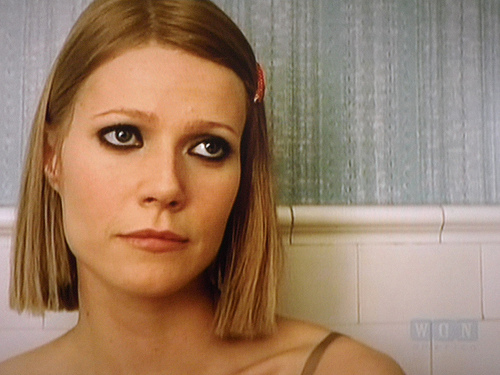
In fact one of the things found I needed to do when I moved to the US was stop saying ‘sorry’ so much and start saying ‘thank you’ more. It’s tied up with the different weightings we give to positive and negative politeness. I wouldn’t like to ‘do a Gwyneth’ for example. She was torn apart by the British Press for this oscar acceptance speech. (http://youtu.be/NG9p1FFwxb0)

I think Americans might have felt she went on rather long, but I doubt they would have described it as “blubbering”, “wailing” or “a sob-fest”, as the British press did. The Daily Mirror commented the next morning: ‘The Bard as ever summed it up: The lady doth protest too much, methinks’.

So could Brits ever have a Thanksgiving day, I wonder? Probably not. It’s not that we don’t like to count our blessings, but something more understated would probably work better.  A “Mustn’t grumble day”, or  a “Could be worse day” perhaps?


 Posted by at 2:56 pm