
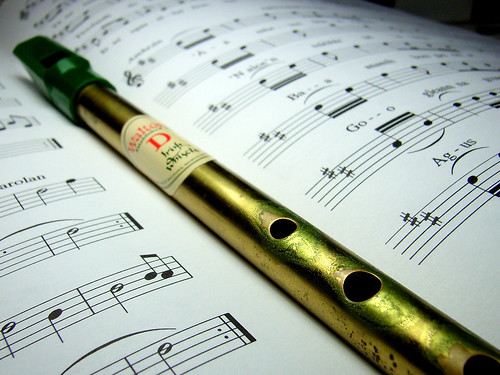
Knowing I’d love it, Chris Adams has kindly sent me this anecdote:
A friend, lets call him Geoff, who is a musician and lived at the time in Australia – a long way back. The Chieftans were on tour and somehow he met them and found out that the tin whistle player had lost, or forgotten his tin whistle – clearly a problem in a traditional irish band. Geoff is among other things a tin whistle player and said
“You can have mine if you like”
The Tin whistle player, brought up in anglo/irish/saxon politeness, said
‘Oh, I couldn’t possibly”
Geoff brought up in Australian directness said.
‘Oh, ok.”
Ha! The intricacies of politeness confound again!

By: Laura
The politeness theorists reckon accepting an offer is rather like going into debt, and we seem to have all kinds of ways to handle it. Expressing gratitude is key, obviously, and building up the the value of the offer is a pretty common strategy. Treat them like they’re offering you an unacceptable million bucks rather than a penny whistle, and make them feel good. But it’s clearly a dangerous strategy in Australia.
When I was in Japan, I learnt a little phrase to use when I was giving my landlady gifts. It was a jolly useful thing to have up my sleeve after I’d transgressed. In fact it’s one of the few Japanese phrases I can remember today, and translated it went something like:
“It’s a humble little thing, but it’s for you.”
‘Humble’ and ‘little’ were appropriate descriptions for the gifts I was giving, but I gather the phrase was also employed with magnificent presents – so a Rolls Royce or diamond bracelet or something.
And there was a ritual that was supposed to go with it. As I recall (and readers in Japan – please correct me if I’ve got this wrong) the polite response from the receiver would be ‘Ee Eeya… Ee Eeya…’ while the gift-giver was supposed to say ‘Dozo… Dozo…’ . So there should be a kind of ‘No, I couldn’t possibly’ – But you must’ -type exchange, after which the gift would eventually be accepted with a ‘Domo arigato’.
My landlady was a wise woman who recognised the risks entailed in cross cultural communication. I may have learnt the phrase for offering the gift, but did that mean I would know the rest of the ritual? She never took chances. Each time I offered my gift, she said thank you and took it right away. I think she’d have thrived in Australia.
Chris, (in my best strine) Ta mate
You got that spot on… be careful not to get sucked into a gift-giving whirlpool of doom, in which the partcipants exchange more and more elaborate presents (with increasingly self-deprecating language) until…. well, it never actually ends.
Oh thank you so much for this Darren. I felt like I was trying to describe the tip of a cultural iceberg here, with no understanding of the hidden 90% or how much things had changed. But you have beautifully described a view from depths I’ve never fathomed. Oh my!
I was once told by someone from one of the Baltic States (sadly I can’t remember which one), that it’s necessary in that culture to turn something down 3 times, and on the 4th go accept it. I probed into this as it sounded fascinating, and it appears that this number is fixed and you really really have to accept on the 4th go. So in fact it seemed to me that it was all an elaborate game with an unchanging outcome, but she assured me that it did work in practice. I still don’t really know how.
Impressively quick!
Good focus on the rituals of exchanging favours or gift giving and receiving. We must not assume they are the same in all languages, cultures and varieties of English. For instance, I was not aware of the directness of the Australian variety which accepted the “I couldn’t possibly” response as a refusal of the favour.
In the Greek language it is pretty much like in English. People will say something such as “You shouldn’t have!” and then the gift giver will say something about how that was nothing etc.
I love your focus on all the issues here in this blog and regularly send my trainees to read you, so keep churning out the good stuff!
Marisa
Thanks for a great story Andy – you have inpired another post.
And thanks for your encouragement Marisa. Yeah, sometimes thanking strategies are similar and sometimes they’re not. In speech act research they’ve identified exaggeration as one we’ll use to respond in English, so saying something like “You’re a life saver” in response to a very small favour like someone lending you an umbrella on a rainy day.
I’ve found my South American students often employ this strategy, and they’ll say things like “You’re my hero”. But it seems to be a bit of a novelty to some of my European students.
This is really interesting. I was just teaching my students the expression “I couldn’t possibly”.
Have you got any insights into the practice of unwrapping gifts? In some cultures it’s common to unwrap the gift right away in the giver’s presence while in others you do it afterwards.
Hi Leo. Thanks for stopping by and yes, when to unwrap is variable as well. I have a vague recollection that Japan might be one of those places where the gift should be put aside for later, but there should be others here who will know.