
When we turn on the news in the morning, we see upbeat, perky news commentators who greet us with happy smiles and cheerful laughter. This is despite the economic meltdown, the vast numbers of unemployed, the BP oil spill, hurricane season starting etc, etc. It seems the sentiment of this old song is still flourishing in the US.
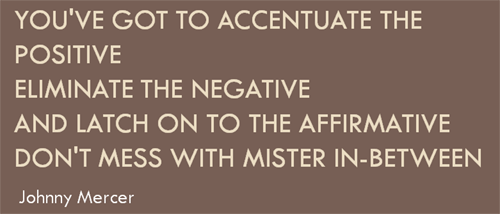
A positive attitude is generally valued on both sides of the Atlantic, but I think it’s more prevalent and deemed more important here. I sometimes hear Americans self-monitoring and saying, ‘Now how can I say that more positively?’ And something similar often goes on in my head when I’m trying to translate my British thoughts into ‘merican. Eliminating the negative, or at least toning it down, is often a big part of the restructuring.
There’s a book called Brit-think, Ameri-think by Jane Walmsley in which she entertainingly maintains:
Well, daft as it sounds, maybe there’s some sense in thinking that way. After all, positive thinking can have some surprising benefits, as some researchers at the University of Cologne recently discovered. They took a group of golfers and told half of them that they were going to use a lucky ball. The other half were told nothing. Can you guess which group performed better on the putting green? Yep – the ones who thought they had luck on their side. It’s not first time this sort of effect has been observed and it’s led psychologists to suggest that optimists might approach life with a positive frame that makes them more open to spotting opportunities, and hence they really do become ‘more lucky’.
So how far should we engage in positive thinking? Should we all start pretending that death is optional, for instance? Jane Walmsley maintains it’s the secret of America’s fundamental optimism, but she also goes on to point out the downside:
There’s a terrific video below in which Barbara Ehrenreich also explores the downside of positive thinking and argues instead for a hefty dose of realism. Very interestingly, she points out that a requirement to ‘think positive’ can operate as a form of social control. When cheerful optimism is mandatory, people who foresee problems get told to shut up or get fired. And if we imagine that problems like extreme inequality, discrimination or poverty can simply be fixed by individual victims ‘thinking positive’, it removes the pressure to solve them.
Barbara is American, and she’s talking about the dangers of positive thinking in the US. But I think a lot of what she’s saying relates to the UK and elsewhere as well. Any thoughts?
(Many thanks to Karenne Sylvester for sending me that great video link)
[…] This post was mentioned on Twitter by Karenne Sylvester and Valentina Dodge, evanfrendo. evanfrendo said: RT @kalinagoenglish: via @vickihollett Positive thinking […]
Vicki,
Really enjoyed reading this and the thoughts it evoked within me. That’s the prime quality of a good blog post, by my accounts!
I really have to disagree with the thoughts about the origins of American optimism. I’ve traveled its breadth a few times and can only point others to a few places for their own conclusions. America does and will remain a contradiction….(because of its space, expanse, as de Tocqueville points out). Miller’s Air conditioned nightmare is a classic and despite the title speaks well of American optimism. But if I had a dime for every philosopher who related the origins of “x” to their attitude to death, I’d be a rich man!
I don’t think optimism is wrong. But it shouldn’t be Walter Mitty like. It should be rooted in action/praxis and reality. A kind of combination of these two fav. optimistic quotes of my own. “You can do a lot, if you don’t know you can’t” and “The more I practice, the luckier I get”. I think America combines the two well. Optimism is great but without realism/reality it is a stale box of chocolates indeed.
If there is/was one philosopher who understood America as an American but also as a French intellect was Lionel Trilling. Can’t recommend his Norton lectures enough and in them all is his fascination with American optimism and his belief that it resides in their essentially “liberal” character and history. But he also noted that in / through time, this American optimism is eroding and I think 40 years on after his death, he is quite right….
David
Well, I’m still quite convinced I can’t die, so that’s definitely the American in me 🙂 Many Americans do have a strong belief that we can do anything.
I remember my first teaching job. I was in a room full of new hires fresh of the CELTA and we were asked if we were truly ready to be teaching Intermediates and up. I and another American raised our hands. All others stayed down. “Of course, the Americans would think so,” replied the senior teacher.
I’m surprised you mentioned Barbara Ehrenreich. I’ve always liked her stuff.
Generally, cultural historians point to the Protestant work ethic when it comes to the belief that you earn what you work for. Coming from Calvinisim, the belief in predestination was a dominant feature of early American culture.
There are many books and accounts of individuals wondering how they could tell if they were predestined for heaven or hell. The conclusion was to look at your life. If you were doing well, you were blessed by God, if not, you were condemned.
This belief slowly combined with the belief in freedom to do what you want and make your own future and eventually transitioned into the work ethic we have today.
As Barbara so rightly points out, this leads to a host of problems as well (i.e. the poor deserving what they get, senses of entitlement by the rich, people believing they have to spend to show wealth & status that represent hard work, etc.)
I loved your post. Positive thinking is very important, but we can’t overdo it. Positive thinking + feet on the ground = success in life.
Completely agree with the statement “Your life is in your own hands”. Have a great day!
Thank you for posting that provocative post and illuminating video. It explains – in an exaggerated and one-dimensional fashion – a strong strand of American culture.
Is false hope better than no hope? Perhaps.
A dying relative, quite religious, beams a smile. She goes on to express joy at leaving the “prison of the body” to embrace “God’s loving light in heaven”. Would you express scepticism or realism? I would not – and suggest that most polite people would not either.
Yet President Clinton – born in Hope, Arkansas, and President Obama – elected on the vaguest notions of “hope” and “change” – reflect this same “mandatory optimism” style as President Bush II. This lends some plausibility of Ehrenrich’s insights. On the other hand, listen carefully to her and just replace the word “hope” with “hopelessness”. What sort of teacher or leader would ever offer utter hopelessness?
Likewise, this optimistic American culture with movies with happy endings reflects the actual life experiences of millions who find technological and material progress has made them happier than previous generations. The traditional American narrative of progress comes from many material and spiritual sources. Obviously, the current economic crisis poses profound challenges to that narrative, yet most Americans expect technological progress to continue and the economy to recover at some point. (Remember that in 1933 the “smartest” voices were backing “scientific” social experiments in Germany and Russia, not the naive American political system).
While the author tries to link the utter failure of a coercive socialist ideology in the former Soviet Union with the “be happy” American social control, a few stunning differences remain. Compare and contrast the levels of optimism and pessimism in folk American and Russian cultures. If nothing else, the utter collapse of the Soviet Union should give self-proclaimed “socialists” and “realists” a tad more humility in dictating solutions to other countries.
Did all that “positive thinking” mantra prevent pervasive pessimism in Soviet culture – or the collapse of the Soviet Union? No. Why? Daily life refuted such absurd claims. The persistence of the American optimism might indicate a different social situation.
I agree that American’s are more positive than anyone else I’ve ever met. I’ve even told my students that, when an American asks how they are, they don’t want to hear anything negative, unless it’s a joke.
I really enjoyed the video and agree that you shouldn’t tell people who’re ‘down on their luck’ that it’s all in their minds. But, I really prefer spending time with optimists and can’t abide fatalists.
David said it well when he said “You can do a lot if you don’t know you can’t.” That’s the kind of optimist that’s most American to me: the kind who work hard, but believe they’re going to do alright.
A little aside: when I have conversations with Germans (I live in Germany) about the problem of the day (global warming, BP, world poverty, AIDS, you name it) and I want to get a rise out of them, I just say “The Americans will think of something.”
“The Americans?” The always ask, as though I’d just suggested a cafeteria full of third graders could solve anything.
“Sure. The Germans regulate the problem, but some American will make a fortune solving it.” It should be noted that my German friends think of me (affectionately, I hope) as their token imperialist.
This was a ramble. I have to practice structuring my comments.
-Toby
David, Nick, Agata, Eric and Toby, thank you so much for these great comments!
David, the point you make about the contradictions encompassed in the US is well taken. I love your two quotes, especially the one that Toby has highlighted: “you can do a lot if you don’t know you can’t”. I think we’ve all experienced that – times when someone’s thought ‘based on my experience, that won’t work’ and then other folks without the skepticism make it happen. Belief can very powerful and exciting.
Nick – Ha! May you live forever.
You reminded me of a interesting experience I had soon after I moved to the US. I had an idea for something we could do on a course that was starting, but it was going to require co-ordination and extra work on the part of the teachers. Pre-conditioned my English staffroom experiences, I was mentally prepared to for a bit of a fight when I pitched the idea at the pre-course meeting. But I was taken aback – there was no tussle at all. Instead of the objections I’d anticipated, the idea was met with a quick ‘Yeah, let’s try it’. I came out of the meeting stunned. As it happened, it turned out to one of my poorer ideas and we needed to abandon it two days later. Ha! But the thing is, as Toby points out, it’s very pleasant to be working in an environment of optimists.
Eric, I’m afraid I don’t understand your point about hopelessness. Barbara said ‘I am not advocating gloom and pessimism or negativity or depression, those can also be delusional’. But you seem to suggest she is offering ‘utter hopelessness’, so I’m a bit confused.
Toby – lovely stories and please feel free to ramble away any time on this blog!
Thank you all.
Maybe I’ve been living away from America for too long – or maybe I was never a ‘normal’ American to begin with…but I generally see the American optimism as a bit of a facade put up to mask the disconcern underneath.
That American waitress with a customer shouting in her right ear, her employer shouting in her left ear and a coffee stain down her blouse isn’t smiling at you because she’s in a good mood or because she’s trying to be positive. She’s smiling because she must smile to keep her job – and her health insurance and be able to pay her rent and buy food and clothing for her children.
And while I do believe that positive thinking can be benefcial, I also think that it can go too far. It cannot make everything perfect. The Charlie-and-the-Chocolate-Factory belief that you can have something because you ‘want it more’ than everyone else just doesn’t ring true. Sometimes, no matter how hard you try, how optimistic you are, and even how talented you might be, somebody else is going to win.
You mentioned lucky golfballs above. Sure, the people with lucky golfballs might have beat their own previous scores, or done better on average…but even if you gave everyone a lucky golfball, somebody would still lose the game.
Of course, I don’t want to say that positive thinking doesn’t have it’s place. The brain is a powerful thing that we are far from understanding. Positive thinking could very well help improve the efficacy of medical treatment. And I generally believe that confidence (ie, believing that you will do well – positive thinking) will improve your results.
But I think the real key is that for those who use positive thinking and get it to work for them – for example an athlete – there is more to it than just thinking. They’re also the ones who *do*.
Of course, there’s always other factors too…such as social standing, genetics and good ‘ol luck.