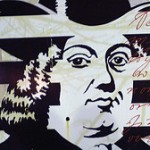


Can’t believe I haven’t told you this story yet, because I love it.
If you’d stopped by in Philly on the night of October 30th in 2008, you’d have thought the inhabitants were nuts. Tens of thousands of Philadelphians all wearing red poured onto the streets, blocking traffic, closing highways, cheering and letting off fireworks.Folks who’d made it to their cars, were driving round hooting their horns and whooping. And why? They believed they’d broken the curse of the city’s founder – William Penn.
Willie Penn was a Quaker which didn’t enamour him with the British crown in the 17th century. In fact he was imprisoned in the Tower of London for a while after writing religious pamphlets. Then along with some other folks he came up with the idea of a mass Quaker exodus to the colonies. They bought a bit of land where New Jersey is now, and then later, somewhat astonishingly, the future King James II gave him a huge wad of land that became Pennsylvania. Quite why, I’ve never heard, but my guess is James thought a mass exodous of Quakers was a jolly good idea too.
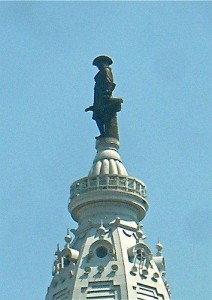
Then we fast forward to 1901. That’s when Willie’s statue was stuck on top of the Philadelphia town hall – a very impressive building in its day and for about 7 years, the tallest building in the world. As time passed, while other American cities put up their skyscrapers, Philadelphia always held off. There was a gentlemen’s agreement amongst developers that no building should rise above the hat on Willie Penn’s head. Come 1987 though the agreement was broken and Philly started growing some very beautiful, but ungentlemanly, skyscrapers. And coincidentally (or as a result in many Philadelphians’ view) Philly sports teams started losing.
Baseball – football – ice hockey – basketball –no team could win a championship. They’d often get through to the final but for nearly three decades they could never quite pull it off. It was like they were jinxed. Local lore had it that it was the curse of Willie Penn.
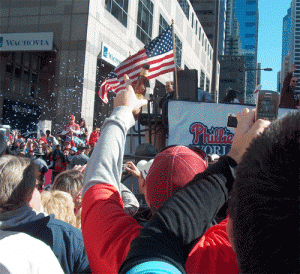
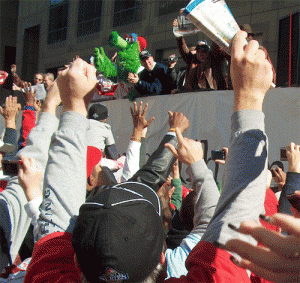
So in 2007, when a whopping skyscraper (the Comcast Tower) was finished, they hit upon the idea of hanging a figurine of Willie Penn on the top. So once more he stood above the city and many reckoned it broke the curse. The very next year the Phillies baseball team won the World Series, and that’s when the city turned into the sea of red (Phillies colour). What a night! And what a parade a few days later too. Literally, millions of people showed up to cheer the team as they rode through the city. Below are some shots I took of the event.
And that is the story of the curse of Willie Penn. Does your city have a similar tale?
Willie’s father, Admiral Sir William Penn, wrote to James II when he was still the Duke of York, asking him to protect his son from further legal troubles. Penn had been tried before the Lord Mayor of London of preaching without a license, but the jury had refused to convict him, inducing the Lord Mayor to send both Penn and the jury to prison for contempt of court. This decision was overturned by the Court of Common Pleas in Bushell’s Case, one of the minor charters of English and American liberty, establishing that juries could not be punished for their verdicts. (Bushell was one of the jurors.)
It’s not clear whether Charles II (not James II, though he agreed with the decision) gave Penn and his backers such a large grant out of personal sympathy or expediency (to get rid of the Quakers, as you say), but in any case it was one of the few things he did right as King. The name “Pennsylvania” was given to the new colony by the King in honor of the Admiral, not Willie himself.
Lovely to hear from you John, as always. And you have explained something that’s puzzled me. Apparently it was Willie Penn’s idea to name the north-to-south streets in Philly after trees. So we have Walnut Street, Chestnut Street, Cherry Street, Pine Street etc. He specifically didn’t want them named after people – such aggrandizement would sit ill with his Quakerly ‘all-equal-before god’-principles. ‘So how come the state is called Pennsylvania?’ I wondered – and now I know. Thank you!
Here’s our local city folklore.
Barcelona glories in two patron saints no less; Eulalia in February and Mercè in September. Even though Eulalia was a catholic martyr tortured in such gruesome ways that she would normally be a ‘fiesta’ superstar, she’s all but forgotten.
That’s probably bacause her Saint’s day falls in dreary February and the Barcelona residents made the apparently sensible decision somewhere back in history to big up the four-day festival of the Mercè which falls in a cheerier period of the year. The thing is though, it invariably, and I mean always, rains through most of the fiesta, putting a real dampener on those open-air concerts. The local legend has it that Saint Eulalia is crying and punishing her fickle followers. The rest of September is usually glorious so who am I to disagree?
Indeed. My father, who was born in the Irish ghetto south of South St. in 1904 (it’s still a ghetto, but not Irish), taught me this rhyme for remembering the principal east-west streets:
[southward] Chestnut, Walnut, Spruce, and Pine;
[northward] Market, Arch, Race, and Vine;
[further northward] Tar and Wood and Turpentine.
Tar and Turpentine vanished when Vine became the Vine Street Expressway; Wood still exists for part of its length only. They were (at least in part) the demimonde district, so building the expressway doubled as slum clearance.
Ha! Who are you to disagree indeed Jesicca – and isn’t that what makes these local folk lores so intrancing. A big thank you for this lovely tale.
Oh thank you John! One of the first things I had to do when I moved into the city was learn a mneumonic for the cross streets. I can’t remember what I made up now but it was something about carelessly (Chestnut) wearing (Walnut) levi (Lombard) socks (South).
The thing that still gives me pause and puzzlement though is how ‘north’ and ‘south’ works in Philly. It’s logical but hard to remember for this Brit. I get the bit about Broad Street being 14th street but after that things go hazy. And that’s another US/UK difference I think. Here folks are brought up to think in terms of N,S,E and W. It’s on all the road signs. In the UK we think about itour route in terms of the towns we’ll be passing through. So rather than route numbers, the towns are named on the road signs and that’s how we find our way.