When I lived in Japan, I was mystified by the street numbers and constantly lost. Alex Case stopped by a while ago and kindly enlightened me. In case you missed his explanation, I’ve just come across this two minute TED video that explains all and some other delightful stuff. Enjoy!
Gosh, if only I had understood that when I lived in Toyko. Now if I could just crack the road signs in Philadelphia,…
There are some funny things that go on with the pronunciation of some French words in British-‘merican. Over here, I park my car in a garAGE and watch balLET and we eat fish filLET. It all sounds a touch poncey and affected to my British ear – though perfectly fine in ‘merican, of course. For more see here.
The recent snow storms meant flights to the US were cancelled to so at 3 am US time I called home to tell my husband that British Airways would be putting me up at the Renaissance Hotel in London. The poor guy dutifully did searches for a hotel called the René Sans.
I used to work in Japan where folks answer negative questions the other way round. I had conversations like this:
Me: Can I have everyone’s homework? <Hiroshi, looks flustered>Haven’t you done your homework, Hiroshi?
Hiroshi: Yes (meaning ‘Yes, I haven’t done it’)
Me: Oh good, can I have it then?
Hiroshi: <head tilted to the side and puzzled expression>
Me: Sorry? Didn’t you say you’d done it?
Hiroshi: Yes (meaning ‘I didn’t say I’d done it’)
Me: Have you left it at home?
Hiroshi: <confused silence>
Hiroshi’s answers are compellingly logical – much more logical than mine if you think about it. Before I knew it, I was answering negative questions the Japanese way too. When I went back to the UK, it took me a couple of years to get my head back to a point where I could teach the English answers confidently in a classroom again.
Now the thing is, this was a structuring problem and it was pretty apparent to Hiroshi and myself that we had a problem here. But there are other things that can go on with negative questions to do with pragmatic force that are harder to spot.
For example, in the Slovak and Croatian languages (Slovak and Croatian speakers – please put me right if I’ve got this stuff wrong) they use negative questions a bit like we might use modals in British and American English to make a question more polite. We can do this in English too, as in a cooingly sympathetic ‘Oh, aren’t you feeling well?’. But more commonly we seem to use negative questions to express (mild) irritation or to indicate that something is not quite what we expect it to be. Eg compare the intent conveyed by ‘Can you hurry up?’ and ‘Can’t you hurry up?’
In Slovak, I gather you’d use a negative question form to sound extra polite and friendly. So you might say things like ‘Haven’t you finished yet?’, and ‘Aren’t you ready yet?’ to enquire about someone’s progress when you want to sound extra pleasant. And obviously native English speakers hear this and think ‘Give us a chance!’ or ‘What are you breathing down my neck for?’
So there’s potential for some relationship damage here. If you don’t know what’s going on, it’s easy to conclude someone has a difficult personality or attitude.
Has anyone else got into trouble with negative questions?
My first teaching job was in Algeria. (For more on my first lesson, see here) It was a fantastic experience, but not without its hassles. I was an unveiled female in her twenties and when I did my shopping in the local market, I generally came back with a couple of bags of groceries and a dozen guys following me. They’d be calling things out to try to attract my attention and it wasn’t a very pleasant experience.
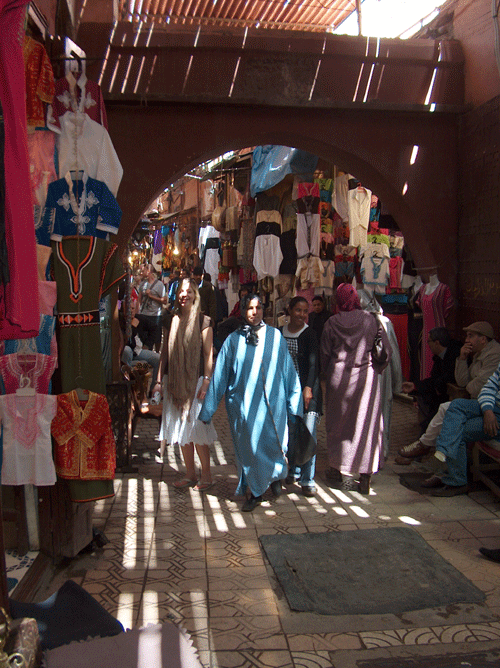
I was reminded of this when my daughter took me to Marrakesh last year. It was a wonderful holiday but my daughter is young and beautiful. She proved difficult to ignore so a stroll through the souk could be a bit trying.
One hot, dusty day we ducked into a shop. I was tired, feeling pestered and and bit irritable. The owner offered tea and made ready to engage in some haggling about a bag my daughter was interested in. I’d had some experience of Algerian hospitality and haggling and realised a refusal was – well, not quite right. But nevertheless I declined both offers. The shop keeper’s response was to patiently try to explain the customs to me and I felt a bit ashamed of myself.
Because haggling can be a fun rewarding game of course, if you’re in the mood and willing to engage. I wonder if it’s one that men are socialised to play more than women in the UK and US. (See here for an article that indicates it might impact on salaries.) So there may be gender differences and there are cultural differences, of course.
Haggling is essentially a conversational routine that’s built around a disagreement. I think something is worth X and you think it’s worth Y. Geoffrey Leech reckoned that politeness dictates that we:
‘Minimize the expression of disagreement between self and other; maximize the expression of agreement between self and other.’
But there are two ways to look at disagreements. Yep, they can drive us apart, but they can also draw us together. It’s possible that through the process of argument and a bit of argey bargey, we can sometimes get to understand one another better and achieve a greater closeness.
And that can lead to a few culture clashes. At the risk of sweeping generalization, in Germany people may appreciate a long, frank exchange of views that enables them to become more informed of the issues. So a German team might want to thrash things out in greater detail than a French team, say, who might feel that agreeing to disagree is a more attractive solution.
Similarly, in Israel, disagreeing bluntly may build closeness and trust. The fact that one person can say disagreeable things to another can also signal solidarity – it indicates they think they are both the same kind of people and who want the same kind of things.
We know there’s tons of cultural variation in how people handle disagreements. In Brazil, a passionate argument may demonstrate healthy enthusiasm for an idea. In Singapore, emotional displays may be seen as a sign of weakness and a lack of control. In Japan, people may prefer to ask a string of questions rather than say they disagree.
But neverthless, on a hot, dusty day, haggling may be a conversational routine that much of the world would rather avoid.
I want to write about haggling and politeness. As time is pressing, I’m going to steal a leaf out of Ken Wilson’s book here and instead say: “Coming soon – something on haggling.”
And in the meantime, I have a taster to whet your whistles which is a lovely anecdote written by Chris. And I know this is getting to be a habit, but when Chris sends me inspirational anecdotes like this, it seems such a shame to leave them lolling about in the comments section. So here’s Chris on haggling:
My first big trip out of Europe was to Mexico and I found a really interesting guidebook before I went which was really a collection of anecdotes and stories rather than specific “go here do this”.
I decided that I wanted to buy a hammock during the trip and that I would need to haggle.
For months I researched everything there was to know about hammocks and identified the village way south where I would make the purchase and trained myself to recognise perfect weave, masterful technique and perfect balance.
My three month visit started in the North, after crossing the US border, and one idle afternoon waiting for a bus I found myself wandering in a small market and I decided to reinforce my knowledge of hammocks by looking at some examples.
I found some, fingered them, inspected them, separated fibres and then wandered off.
“Hey, gringo, you wanna but hammock”
‘No, gracias, it’s ok”‘
“I make special price..”
“No, it’s cool, I’m not interested, thanks.”
‘4oo pesos.”
“No, thanks, I’m really not interested.
“300 pesos’
“Thanks, it’s a really nice hammock but I don’t need it.’
“Ok, 200 pesos”
I really knew I was going to buy a hammock in the village that made the best ones in Mexico so I really wasn’t interested.
And I walked away.
“100 pesos”.
And I got on the bus.
And I sat there , looking out of the window, thinking about all the research I had done.
THAT hammock had ticked off against EVERY check that answered the question – is it the best?
Except – village.
I NEVER found another hammock even a bit close in the next three months of travel!
Thanks again Chris! And has anyone else had interesting haggling experiences?


 I was reminded of this when my daughter took me to Marrakesh last year. It was a wonderful holiday but my daughter is young and beautiful. She proved difficult to ignore so a stroll through the souk could be a bit trying.

