Vicki

Teacher of professional and technical English, writer and teacher trainer.

Jan 112010
 

Lahic, Azerbaijan by indigoprime.

Many thanks to Andy Hockley for sharing this lovely story:

I was once told by someone from one of the Baltic States (sadly I can’t remember which one), that it’s necessary in that culture to turn something down 3 times, and on the 4th go accept it. I probed into this as it sounded fascinating, and it appears that this number is fixed and you really really have to accept on the 4th go. So in fact it seemed to me that it was all an elaborate game with an unchanging outcome, but she assured me that it did work in practice. I still don’t really know how.

Fascinating indeed. I read somewhere about some Americans who had someone from Azerbaijan staying with them. Their guest seemed to settle in OK and she was very pleasant until it came to meal times. Whenever they offered her food or drink, she refused and they were getting worried. Did she not like their cooking or was it their company?

They later discovered that in Azerbaijan it’s customary practice to refuse an offer the first time it’s made. It’ll get repeated and you can accept it politely later. I’m not sure whether it was on a specific third or fourth time or just thereabouts, but clearly it’s a habit Azerbaijanis will want to lose fast when they’re travelling, or they’ll get very hungry.

I wanted to include the incident in a book, but finding an Azerbaijani accent was a bit of a challenge for the audio recording crew. A bit of invesitgation revealled similar things can happen in  parts of China, but it seems to be associated with an older generation. And I gather similar things can happen in Iran too where it’s part of a broader system of T’aarof. But again, it’s disappearing with younger generations.

So if anyone knows of countries where this system is alive and well, please share. And I wonder, do you think younger generations in anglo English cultures might be getting more direct as well?

 Posted by at 5:59 pm
Jan 072010
 

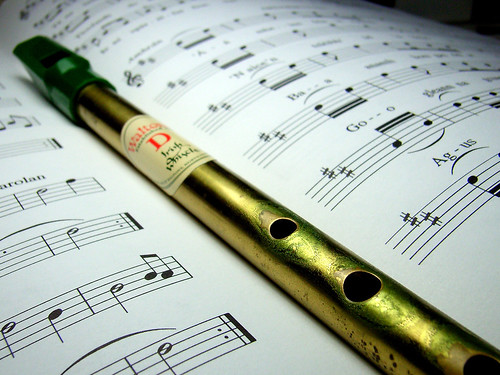
Whistle by chidorian.

Knowing I’d love it, Chris Adams has kindly sent me this anecdote:

A friend, lets call him Geoff, who is a musician and lived at the time in Australia – a long way back. The Chieftans were on tour and somehow he met them and found out that the tin whistle player had lost, or forgotten his tin whistle – clearly a problem in a traditional irish band. Geoff is among other things a tin whistle player and said
“You can have mine if you like”
The Tin whistle player, brought up in anglo/irish/saxon politeness, said
‘Oh, I couldn’t possibly”
Geoff brought up in Australian directness said.
‘Oh, ok.”

Ha! The intricacies of politeness confound again!

By: Laura

The politeness theorists reckon accepting an offer is rather like going into debt, and we seem to have all kinds of ways to handle it. Expressing gratitude is key, obviously, and building up the the value of the offer is a pretty common strategy. Treat them like they’re offering you an unacceptable million bucks rather than a penny whistle, and make them feel good. But it’s clearly a dangerous strategy in Australia.

When I was in Japan, I learnt a little phrase to use when I was giving my landlady gifts. It was a jolly useful thing to have up my sleeve after I’d transgressed. In fact it’s one of the few Japanese phrases I can remember today, and translated it went something like:

“It’s a humble little thing, but it’s for you.”

‘Humble’ and ‘little’ were appropriate descriptions for the gifts I was giving, but I gather the phrase was also employed with magnificent presents – so a Rolls Royce or diamond bracelet or something.

And there was a ritual that was supposed to go with it. As I recall (and readers in Japan – please correct me if I’ve got this wrong)  the polite response from the receiver would be ‘Ee Eeya… Ee Eeya…’  while the gift-giver was supposed to say ‘Dozo… Dozo…’ . So there should be a kind of  ‘No, I couldn’t possibly’ – But you must’ -type exchange, after which the gift would eventually be accepted with a ‘Domo arigato’.

My landlady was a wise woman who recognised the risks entailed in cross cultural communication. I may have learnt the phrase for offering the gift, but did that mean I would know  the rest of the ritual? She never took chances. Each time I offered my gift, she said thank you and took it right away. I think she’d have thrived in Australia.

Chris, (in my best strine) Ta mate

 Posted by at 10:30 pm
Dec 282009
 

Learning to speak ‘merican is like trying to: catch the rain, nail jello to the wall, shoot pool with a rope, fold the New York Times in a high wind, leave New Orleans when a hurricane is coming, change the course of the Niagara Falls with a bucket…

However, one of the fun things about learning to speak ’merican is the metaphors. Here’s a lovely video in which James Geary points out that Elvis Presley was a master, along with some more serious stuff like:

Whenever we give a name that belongs to something else, we give it a whole network of analogies too, and these analogies influence the decisions we make.

 Posted by at 6:02 pm
Dec 242009
 

Lights

Won't you glide my sleigh tonight by MoToMo.


Happy holidays by Valerie Everett.


What do you make of displays like these?

Pantos

Say ‘panto’ and ‘mericans will probably think you mean mime. It’s a UK tradition that hasn’t made its way across the pond. But if you explain that you’re homesick and ask your friends nicely, they may humour you and join in performing one. It’s a genre that seems to transfer well across the pond to me. (Oh no it doesn’t, Oh yes it does)

TV

‘The Great Escape’ seems noticeably absent from the TV channels. (Phew!) Expect many renditions of ‘It’s a Wonderful Life’ instead. (Argh!)

Other entertainments

The Nutcracker at the ballet seems to be the quintessentially holiday show here. And if you’re in or near NYC, do try to get to the Radio City Music Hall Christmas show once in your life for a truly cross cultural experience. The Roxettes are reminiscent of the Tiller girls, but there are more of them.

Radio City Christmas Show - Rockettes-4 by Bob Jagendorf.

Time off

Boxing Day is unknown. Don’t let the word ‘holidays’ fool you into thinking ‘mericans take time off work. Things shut down on Christmas day, but that’s about it. Folks will be back to work on the 26th. 

Happy holidays

Wishing y’all (everywhere in the world) happy holidays/Christmas.

 Posted by at 12:31 pm
Dec 202009
 

What to say
Forget ‘Merry Christmas’. The standard greeting is ‘Happy holidays’. It covers Kwanzaa and Hannukah too and, as is generally the case here, being inclusive matters.
Timing ‘
The holiday season runs from late November till early January. Americans complain that stores decorate and play seasonal tunes earlier and earlier, but compared to the UK, they seem very restrained to me. Not much seems to start till after Thanksgiving (the fourth Thursday in November) but then things get going with a bang – a big bang. In Philly the day after Thanksgiving is known as ‘Black Friday’ – a day when shops have big sales and drivers spend hours in traffic jams trying to get to the malls.
Shopping concerts
organIf you’re in Philly, pop into Macys and check out the organ. It’s the largest organ in the world. (Well, there’s something I never expected to write about!) There’s an organist performing regular free concerts for shoppers all year round who is joined by carole singers in the holidays. People go to just listen to the show
Crackers
I had trouble finding crackers in the US ten years ago, but they’ve started appearing in stores in recent years. But it’s interesting to see how they’ve been adapted for a different market. They often contain mottos with wise words about life and living, rather than corny jokes. And they contain novelties that you’d hesitate to throw in the bin. From my British frame, they are altogether too durable and functional.
cracker-jokeSo if you are planning a party and can import crackers from the UK, I would. I mean, who really needs a silver nail clipper?

But bear in mind that UK crackers need explanation. The novelties are likely to mystify so expect bemused expressions as your guests wonder ‘But why would you think I might want a tacky set of 10 mini plastic skittles, Vicki?’ Similarly, be prepared for a baffled silence when you ask your riddle.
Very charmingly, you can also expect astonishment and admiration at your own abilities to second guess the daft school boy jokes, Enjoy it while it lasts. After just a few years of your turkey and training, the ‘mericans at your table will be better at them than you.

 Posted by at 11:07 am